liveBook · Manning

Apache Airflow

As explained in Delivering Machine Learning Projects: From design to deployment

Airflow is an open-source platform for authoring, scheduling, and monitoring programmatic workflows.

Apache Airflow is a pipeline engine for authoring, scheduling, executing, and monitoring complex programmatic data workflows. It abstracts task chaining and execution management across diverse technical stacks. section 4.3.3

Airflow is useful when AI and data projects contain many dependent processes:

  • Manage imports and data preparation for exploratory data analysis. section 4.3.3
  • Coordinate model training, evaluation, and production workflows. section 4.3.3
  • Make processes inspectable while outsourcing bookkeeping and script management to an execution engine. section 4.3.3
Figure 4.1 An example DAG: it’s directed (D) as the information flows one way along the arrows. It’s acyclic (A) because there aren’t any cycles, and it’s a graph (G) because that’s what this sort of thing is called.
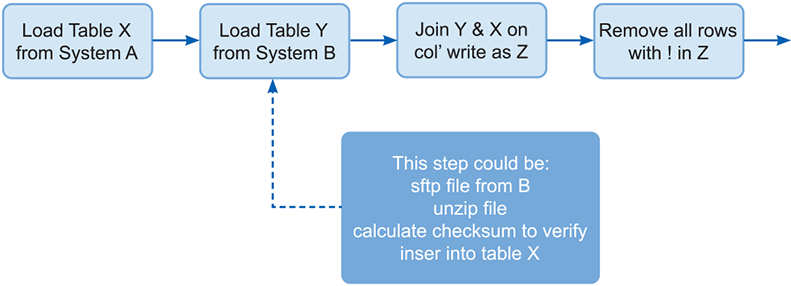
Use the DAG figure to inspect how directed, acyclic task dependencies represent a workflow. section 4.3.3


How Delivering Machine Learning Projects: From design to deployment covers it

How deep it goes
Explains pipeline abstraction, task chaining, execution management, and inspectability without detailing Airflow implementation.
Examples
Uses DAG-shaped workflows and processes for importing data, preparing features, training models, evaluating models, and deploying production flows.
What you can do after
Operate and inspect chained data processes while reducing manual bookkeeping, script-management effort, and workflow error.
How it connects
Connects pipeline orchestration with Hadoop, Oozie, data assets, exploratory data analysis, model training, and model evaluation.

Also explained in

Compare how 5 books explain Apache Airflow →

Related concepts

This explainer was generated by Manning's knowledge graph from the text of Delivering Machine Learning Projects: From design to deployment. The section links point to the parts of the book it draws on.


