An API integrator incorporates a third-party generative AI model into its own systems through an API. For example, a customer-support chatbot can send queries to GPT-4 or Claude and return answers inside a web application. The organization can tailor the workflow, but data flows to an external model and core model functionality remains dependent on the vendor. section 2.1
This posture divides control between the organization and the vendor. The organization maintains its user interfaces and data management systems; the vendor supplies the model. Compared with using a vendor’s SaaS application, API integration provides more customization but adds governance responsibilities. section 2.3
Figure 2.1 Different types of GenAI adoption. SaaS Consumers have the least control and highest vendor dependency, Model Hosters the highest control and lowest vendor dependency
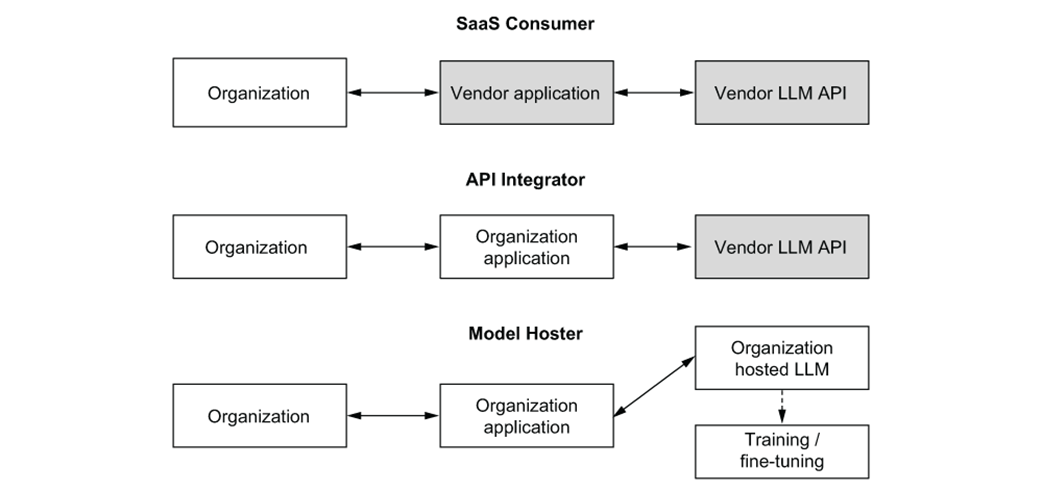
Compare the control and vendor-dependency spectrum across SaaS consumption, API integration, and model hosting. section 2.1
Design safeguards around both the application and its external model boundary:
- Add output safeguards to vendor protections where needed. Llama Guard, NeMo Guardrails, or Lakera can scan for toxic language, prompt injection patterns, and recognizable personal information formats. section 5.4.3
- For retrieval-augmented generation, enforce document-level access so users retrieve only authorized content. Retrieval permissions are separate from output filters; test and monitor them because vector search can behave unpredictably. section 5.4.3
- Plan access, correction, and deletion requests across organization-controlled prompt logs, stored outputs, retrieval documents, and embeddings. Explain what the external provider receives and may retain under the contract. section 5.5.4
Claimant data in an integrated application
ElectraMotors runs ClaimAssist and decides why claimant data is used and which systems store it. It remains responsible for data subject requests in those layers. A contractor operating the integration under its instructions is different: it is usually a processor and must help answer those requests. section 5.5.4

