Applied cryptography deploys cryptographic algorithms and protocols in real applications, where attackers, performance, input and output sizes, and implementation choices all matter. section 1.6
It protects everyday systems by combining:
- Confidentiality for private data and identities. section 1.9
- Authentication for verifying people, data, or messages. section 1.9
- Symmetric and asymmetric primitives, including encryption, key exchange, and digital signatures. section 1.9
Its threat model extends beyond network interception: endpoints, operating systems, shared machines, payment terminals, and data centers may already be compromised. Security therefore depends on stated assumptions about attackers. section 13.1
A skimmer at an ATM
A malicious reader can copy card data, while a hidden camera may capture a PIN. This illustrates why protecting data in transit is not enough. section 13.1
Figure 13.1 A skimmer, a malicious device that can be placed in front of ATM or payment terminal card readers in order to copy data contained in the card magnetic stripe. The magnetic stripe usually contains the account number, the expiration date, and other metadata that’s used by you to pay online or in a number of payment terminals. Skimmers are sometimes accompanied with a hidden camera to obtain your PIN as well, potentially enabling the thief to use ATM withdrawals and payment terminals enforcing PIN entry.
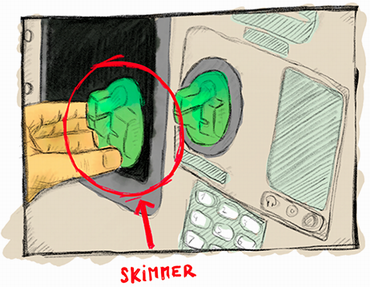
Use the skimmer figure to inspect a concrete payment-terminal attack and its captured data. section 13.1
