Theoretical cryptography studies cryptographic constructions, properties, and security foundations, usually through academic research rather than immediately deployable code. It defines idealized security models and sometimes produces techniques that later become practical. section 1.6
It differs from real-world cryptography in emphasis:
- Models security properties such as authentication, confidentiality, and signature unforgeability. section 1.9 section 7.4.1
- Often assumes trusted execution environments and focuses on network attackers, while deployed systems may face compromised devices, skimmers, shared hosts, or hostile facilities. section 13.1
- Can miss practical edge cases when formal models do not capture how primitives are composed or deployed. section 7.4.1
Signature substitution
EUF-CMA may regard a signature as secure even though an attacker can construct another key pair that validates the same signature, or a new message and key pair that validate under the original signature. section 7.4.1
Figure 13.1 A skimmer, a malicious device that can be placed in front of ATM or payment terminal card readers in order to copy data contained in the card magnetic stripe. The magnetic stripe usually contains the account number, the expiration date, and other metadata that’s used by you to pay online or in a number of payment terminals. Skimmers are sometimes accompanied with a hidden camera to obtain your PIN as well, potentially enabling the thief to use ATM withdrawals and payment terminals enforcing PIN entry.
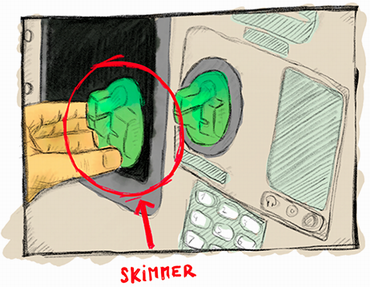
A skimmer illustrates why theoretical assumptions about trusted endpoints can fail in physical payment systems. section 13.1
