An arc is a connected portion of a circle bounded by endpoint angles. In geometric motion, arcs provide curved building blocks that can be joined with straight lines to form smooth trajectories. section 5.3
An arc becomes useful when a trajectory must combine curvature with predictable movement:
- Parameterize circular motion by equal portions of the circle so movement advances at a constant speed. section 5.3
- Find the arc center by rotating and scaling a tangent vector from an endpoint. section 5.3.2
- Join the arc to a line segment by making the radius at their intersection orthogonal to the segment, producing a gentle transition. section 5.3.2
A constant-speed bug trajectory
Instead of moving a game character along a polynomial spline with a changing parameter pace, split its path into lines and arcs. Increase the line parameter uniformly, or advance the circular parameter in equal portions, so each time step covers a proportional distance. section 5.3
Figure 5.21 An arc can be joined smoothly with a line segment so that we have both straight and curvy pieces in one building block.
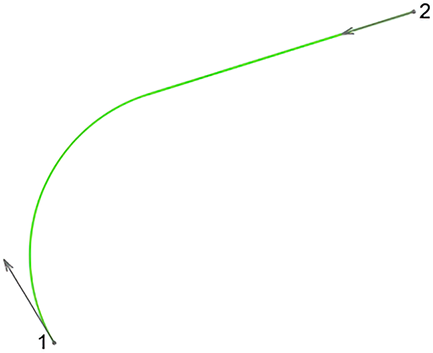
Use the figure to see how an arc and a straight segment meet as one smooth building block. section 5.3.2