liveBook · Manning

ARES

As explained in Retrieval Augmented Generation, The Foundational Ideas

ARES is an automated evaluation framework that trains specialized judges and applies statistical inference to evaluate retrieval-augmented generation systems.

ARES is an automated evaluation framework for retrieval-augmented generation systems. It replaces prompt-only LLM judges with specialized evaluators and adds statistical inference, addressing score instability from small prompt variations. section 14.3 section 14.3.2

ARES builds evaluation in three stages:

  • Generates domain-specific synthetic query, passage, and answer triples, including relevant and irrelevant contexts, faithful and contradictory answers, and relevant or irrelevant answers. section 14.3.2
  • Fine-tunes lightweight DeBERTa-v3-Large binary classifiers for context relevance, answer faithfulness, and answer relevance. section 14.3.2
  • Combines judge predictions with approximately 150 human-annotated validation examples through prediction-powered inference to produce confidence intervals. section 14.3.2 section 14.7
Figure 14.4 The ARES three-stage evaluation pipeline.
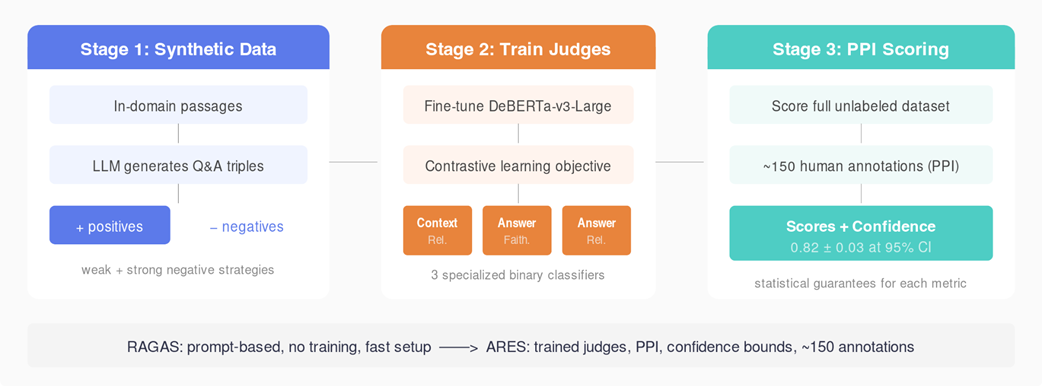
The pipeline diagram connects synthetic training data, specialized scoring models, and statistically grounded quality claims. section 14.3.2

How Retrieval Augmented Generation, The Foundational Ideas covers it

How deep it goes
Descends from synthetic-data generation through classifier training and PPI confidence intervals, but does not detail implementation code.
Examples
Uses in-domain passages, synthetic positive and negative triples, specialized binary judges, and approximately 150 human-annotated outputs.
What it assumes
Assumes a domain corpus and a small human preference validation set while generating evaluation examples from the corpus.
What you can do after
Evaluate RAG changes with specialized judges and confidence intervals that help distinguish real regressions from measurement noise.
How it connects
Connects LLM-as-judge evaluation with RAGAS, G-Eval, prediction-powered inference, and continuous RAG evaluation.

Related concepts

This explainer was generated by Manning's knowledge graph from the text of Retrieval Augmented Generation, The Foundational Ideas. The section links point to the parts of the book it draws on.