Traversal visits nodes by following edges from one or more starting points. In retrieval systems, it replaces one broad similarity lookup with a directed walk through a hierarchy or graph, narrowing context as it proceeds. section 12.1 section 10.5.2
Two retrieval patterns show why the traversal strategy matters:
- Hierarchical traversal starts at root nodes, selects the top-k matches, scores only their children, and repeats until reaching leaves. Pruning an irrelevant branch prevents its chunks from polluting the context. section 10.5.2
- Collapsed retrieval flattens roots, summaries, and leaves into one vector space, making a single search faster and simpler but more vulnerable to wrong abstraction levels and noisy large indexes. section 10.5
- Graph traversal follows relationships from query-linked entities to reachable evidence, supporting multi-hop recall where related facts share little or no vocabulary. section 12.1
Pruning an irrelevant branch
For a Finance query, traversal can select a relevant root branch and score only its descendants. Once the HR branch is pruned, HR chunks cannot enter the context merely because their embeddings happen to be similar. If queries usually target leaves, starting at a lower tree level can skip redundant searches. section 10.5.2
Figure 10.5 Indexing and Retrieval Strategies.
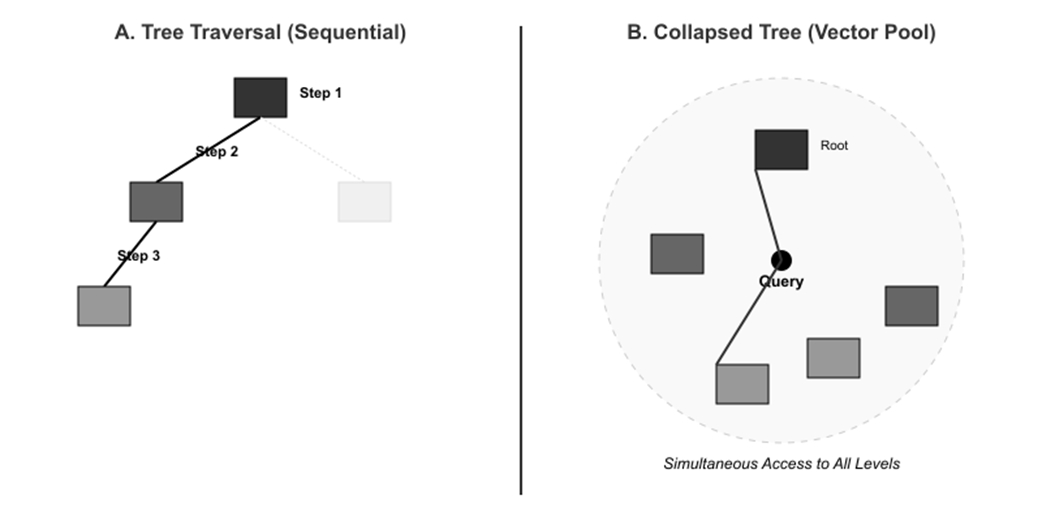
Compare hierarchical traversal with collapsed retrieval as two ways to index and query a tree-organized retrieval structure. section 10.5




