Asset allocation distributes a portfolio across asset classes to match an investor’s suitable risk level and objectives. Robo-advisor allocations commonly diversify between stocks and bonds, while differing in non-US exposure and growth or value emphasis. The underlying instruments are generally liquid and exchange-traded rather than private equity, venture capital, or real estate. section 1.1.1
Allocation decisions become operational through several related choices:
- Set target weights, then rebalance when returns cause positions to drift; rebalancing can follow a threshold or schedule and may account for taxes. section 1.1.1
- Treat guaranteed lifetime income, including Social Security, pensions, and annuities, as bond-like resources that can reduce the need for bonds while addressing longevity risk. section 1.3
- Distinguish asset allocation’s risk-and-reward trade-offs from asset location, which distributes assets among taxable, tax-deferred, and tax-exempt accounts to reduce taxes. section 1.3
- Choose allocations over multiple periods as wealth and time to a goal change, producing a glide path whose stock weight can vary with the realized wealth path. section 6.6
Goal-based stock–bond allocation
For a $2 million terminal wealth goal, represent possible wealth levels as discrete states and evaluate each candidate allocation by its probability of reaching later states. A helper computes portfolio mean return and volatility from stock and bond weights; transition probabilities then come from a normal-return assumption. Backward dynamic programming selects, at each wealth state and time, the allocation with the highest expected probability of reaching the goal. A 100% risk-free-bond allocation requires explicit handling because its volatility is zero. Alternative return distributions, including fat-tailed ones, can replace the normal assumption. section 6.2.1
Optimization-based allocations depend critically on expected asset returns and return covariances, and resulting portfolios can be highly sensitive to expected-return inputs. The Black–Litterman model addresses that sensitivity while allowing views about future asset returns to enter the allocation process. section 12.0
Figure 6.4 Asset allocations for the three paths of wealth
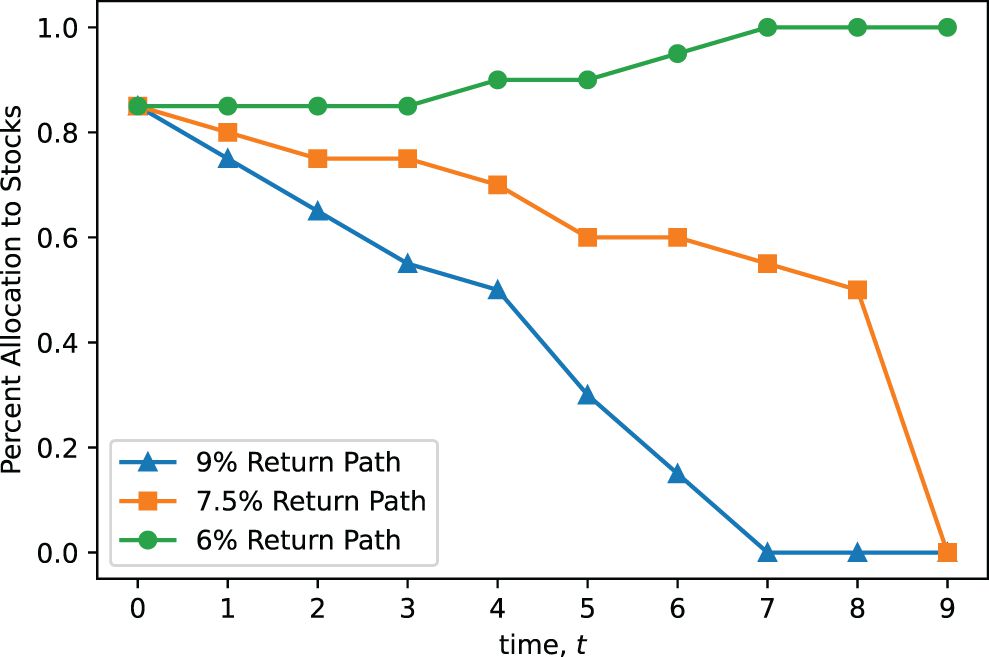
Compare the stock allocations selected along three wealth paths to see why a goal-based glide path need not follow one fixed schedule. section 6.2.1
