A glide path is a sequence of portfolio allocations that changes investment risk over time. A common retirement-oriented version reduces risk as an investor ages: by retirement, when employment income ends, it assigns a lower-risk portfolio. Robo-advisors may apply such paths automatically, while some instead leave lifetime risk choices to the client. section 1.1.1
The practical question is not merely whether stocks should decline over time, but how allocation should respond to a financial goal. For an investor starting with $1 million and aiming for $2 million in 10 years, with annual allocation changes and no interim saving or spending, the glide path is the changing asset allocation used to pursue that goal. Target-date mutual funds conventionally rebalance stock and bond funds on a predetermined path, though an alternative view argues for rising equity exposure over time. section 6.1
A predetermined time-only path can miss a critical input: wealth. In a dynamic-programming policy, the optimal allocation is an action A(W,t), depending on both current wealth W and time t. The value function gives expected future reward; with reward 1 for reaching the goal and 0 otherwise, it is the probability of success. The policy can then select the allocation that maximizes that probability at every wealth-time state. section 6.2.1
Three wealth paths, three allocations
Start with an 85% stock allocation for the difficult doubling goal. Under a medium path with 7.5% annual wealth growth, the stock allocation gradually declines. By t=9, wealth can be sufficient to meet the goal with certainty in the risk-free bond, so further stock risk has no value under the binary-goal reward. Comparing good, medium, and bad wealth paths illustrates why an optimal glide path cannot be specified without the wealth path. section 6.2.1
A dynamic implementation proceeds by:
- Defining the goal, time horizon, wealth states, and a discrete set of asset-allocation actions. section 6.1 section 6.2.1
- Computing transition probabilities between next-period wealth states for each current wealth, time, and allocation. section 6.2.1
- Working backward from the terminal goal state, storing the maximum expected value and allocation choice at each state. section 6.2.1
- Reading allocations along candidate wealth paths rather than treating a single calendar-time schedule as universally optimal. section 6.2.1
Figure 6.4 Asset allocations for the three paths of wealth
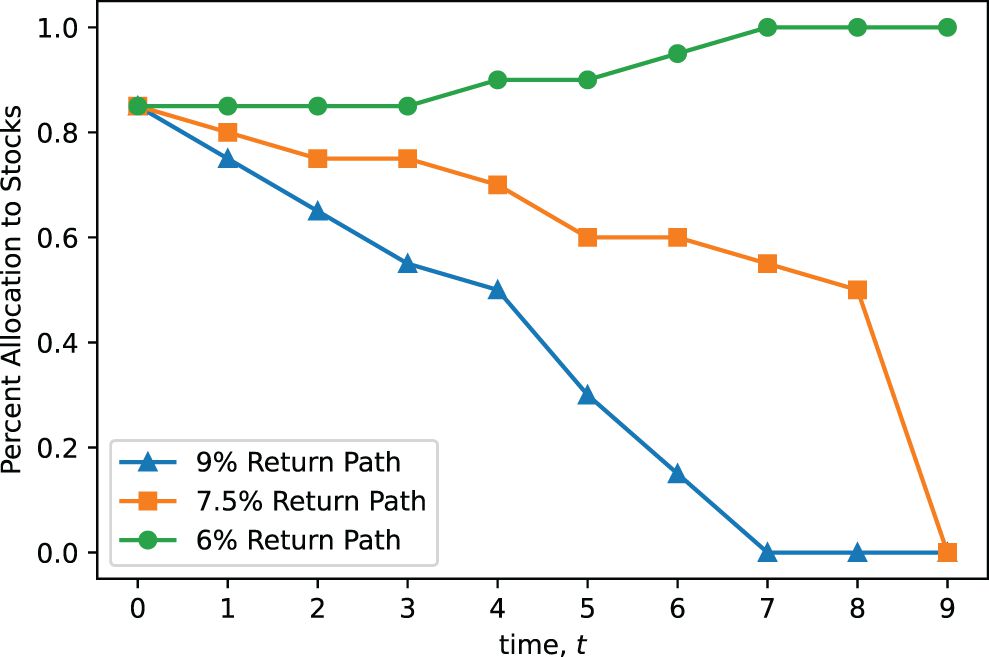
Compare stock allocations across good, medium, and bad wealth paths to see the policy vary with both wealth and remaining time. section 6.2.1
