Assured Forwarding (AF) is a standardized DSCP marking scheme for carrying QoS intent across a network. It divides markings into four traffic classes, with three drop-precedence levels per class, creating 12 AF markings. The five most significant DSCP bits identify the class and drop precedence; the sixth bit remains 0. section 10.3.3
Use AF markings to express both traffic class and relative discard preference:
- Select one of four AF classes for the traffic type. section 10.3.3
- Select drop precedence 1, 2, or 3 within the class; higher precedence indicates greater susceptibility to dropping during congestion. section 10.3.3
- Use the markings as part of an end-to-end DSCP policy rather than relying on locally significant PCP markings. section 10.3.3
Recommended traffic classes
RFC 4594 recommendations associate AF4x with real-time interactive traffic such as gaming, AF3x with multimedia streaming, and AF2x with low-latency client–server data. The same recommendations use EF for telephony, DF/CS0 for standard best-effort traffic, and CS1 for low-priority traffic. section 10.3.3
Figure 10.14 The AF marking system. The five most significant bits are divided into the class (3 bits) and drop precedence (2 bits). The sixth bit is always 0.
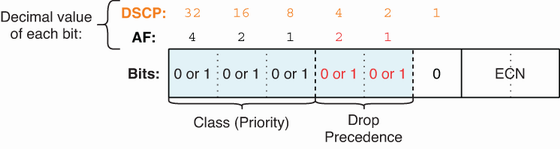
Inspect the bit layout showing how AF divides the DSCP value into class and drop precedence. section 10.3.3
