DSCP is a six-bit field in IPv4 and IPv6 headers that marks a packet for a desired forwarding treatment. Devices can classify packets by reading DSCP instead of repeatedly inspecting addresses, ports, or payloads, reducing configuration and processing effort. section 10.3.2 section 10.3.3
Use these facts to distinguish DSCP from related marking fields:
- Provides 64 possible values, from 0 through 63, because the field is six bits wide. section 10.3.3
- Remains with the IP packet end to end unless another device changes the marking. section 10.3.3
- Differs from PCP or CoS, which occupies three bits in an 802.1Q tag and exists only in tagged Ethernet frames. section 10.3.2 section 10.7
- Uses standardized markings such as DF (0) for best-effort traffic and EF (46) for delay-, jitter-, or loss-sensitive traffic. section 10.3.3
- Includes Class Selector markings for compatibility with the older three-bit IP Precedence system. section 10.7
Voice and best-effort traffic
A network can mark voice-call traffic with EF, represented by binary 101110 and decimal 46, while ordinary traffic uses DF, represented by binary 000000 and decimal 0. Later devices can classify packets from these markings. section 10.3.3 section 10.3.2
Figure 10.9 Complex classification and marking should be done early in a packet’s life. Subsequent devices can then simply classify it based on its marking.
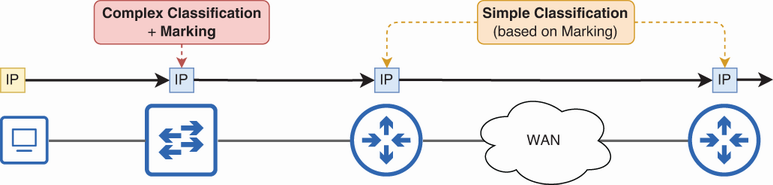
Shows why complex classification and marking should occur early, allowing subsequent devices to classify packets from their markings. section 10.3.2
