Marking sets packet or traffic header fields to encode classification information, allowing later devices to apply QoS policies without repeating complex classification. section 10.3 section 10.3.2
Figure 10.9 Complex classification and marking should be done early in a packet’s life. Subsequent devices can then simply classify it based on its marking.
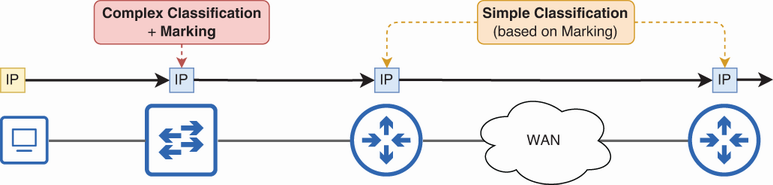
Follow the packet path from complex early classification and marking to simpler classification by downstream devices. section 10.3.2
Use the appropriate marking field for the packet or frame:
- DSCP occupies six bits in IPv4 and IPv6 headers, providing 64 values from 0 through 63. Default Forwarding uses 0 for best-effort traffic, while Expedited Forwarding uses 46 for delay-, jitter-, or loss-sensitive traffic such as voice. section 10.3.2 section 10.7
- PCP, also called CoS, occupies three bits in the 802.1Q Ethernet tag and provides eight values. The default value 0 means best effort; the standard voice value is 5. section 10.3.2
- PCP applies only while an 802.1Q tag exists, such as on trunk links or voice VLAN access links; traffic between routers does not normally carry it. section 10.3.2 section 10.7
A trust boundary separates trusted from untrusted markings. Devices forward trusted markings unchanged, but re-mark untrusted traffic according to policy. IP-phone markings are commonly trusted, whereas PC markings should usually be re-marked to prevent users from claiming priority. section 10.3.4
Phone and PC traffic
An IP phone marks audio packets, commonly with EF, and a switch can trust that marking. A connected PC remains untrusted, so a PC-generated EF marking is replaced with the configured policy value. section 10.3.4
