A trust boundary is a logical network division that separates packet markings a device accepts from markings it reclassifies. Trusted markings pass through unchanged; untrusted markings are rewritten according to policy. A common boundary places IP phones on the trusted side and PCs on the untrusted side, preventing users from claiming preferential QoS treatment. section 10.3.4
Apply the boundary according to the device generating the marking:
- Trust IP phone markings, typically EF for actual voice audio, so the switch forwards them without modification. section 10.3.4
- Do not trust PC markings; re-mark packets from PCs to the appropriate value under the configured QoS policy. section 10.3.4
- Use the boundary to protect preferential treatment from inaccurate or deliberately manipulated QoS markings. section 10.3.4
Figure 10.16 Typical trust boundaries. IP phones mark their packets, and it is standard practice to trust them. Markings from PCs should usually not be trusted.
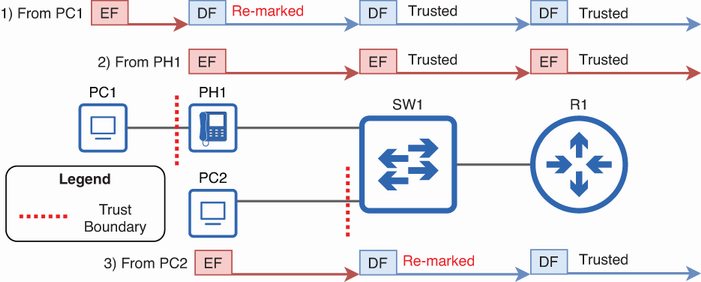
Visualizes the typical placement of a trust boundary between trusted IP phone markings and untrusted PC markings. section 10.3.4
