liveBook · Manning

Core layer

As explained in Acing the CCNA Exam: Volume 2 Advanced Networking and Security

A core layer is the campus-network layer that aggregates connections between distribution layers in large LANs.

A core layer aggregates connections between distribution layers in a large campus LAN. Adding it reduces the connection complexity that a full mesh creates as distribution blocks multiply. section 15.2 section 15.2.2

Design the core layer around fast, reliable Layer 3 forwarding:

  • Use a core when a campus has three or more distribution blocks; Cisco also identifies a partial mesh as an alternative. section 15.2.2
  • Use high-end switches focused on speed, reliability, rapid packet forwarding, and continued connectivity during failures. section 15.2.2
  • Make every core-to-distribution connection Layer 3 and use a routing protocol such as OSPF to exchange routing information. section 15.2.2
  • Avoid CPU-intensive security features and QoS marking; trust and forward packets using their existing QoS markings instead. section 15.2.2
Figure 15.6 Two-tier vs. three-tier architectures with four distribution blocks. In the two-tier LAN, each distribution switch has seven connections. In the three-tier LAN, each distribution switch has only three connections.
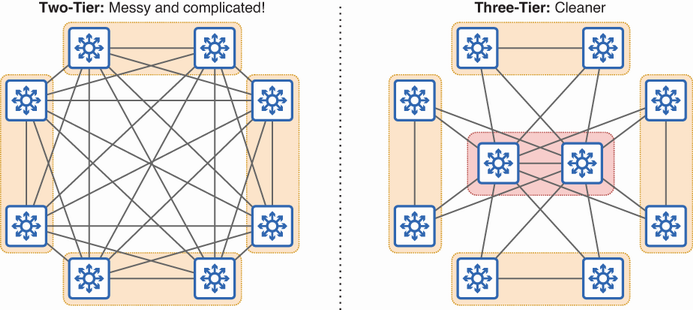
Compare two-tier and three-tier designs: with four distribution blocks, the three-tier design reduces each distribution switch from seven connections to three. section 15.2.2

How Acing the CCNA Exam: Volume 2 Advanced Networking and Security covers it

How deep it goes
Explains placement, performance goals, processing limits, Layer 3 links, and OSPF, but does not provide device configuration commands.
Examples
Uses a four-distribution-block comparison and a three-building campus topology to illustrate connection reduction and layer placement.
What it assumes
Assumes familiarity with hierarchical campus LANs and distribution blocks while defining the core’s role and design rationale.
What you can do after
Evaluate when to add a core and identify appropriate core links, forwarding priorities, and processing restrictions.
How it connects
Connects the core layer to campus LAN architecture, distribution layer, Layer 3, OSPF, STP, QoS, and security features.

Related concepts

This explainer was generated by Manning's knowledge graph from the text of Acing the CCNA Exam: Volume 2 Advanced Networking and Security. The section links point to the parts of the book it draws on.