A core-distribution layer combines the campus core and distribution functions in a two-tier LAN, leaving access switches as the only separate layer. It aggregates access connections and typically connects the LAN to the corporate WAN or internet. section 15.2.1
Recognize the layer by its operational roles:
- Connects to access switches through Layer 2 trunk links. section 15.2.1
- Connects to external network areas through Layer 3 routed ports. section 15.2.1
- Uses multilayer switches, redundant default gateways, and routing protocols such as HSRP and OSPF. section 15.5
SVI configuration
A distribution switch can configure VLAN 10 with an IP address, assign an HSRP virtual IP and priority, and enable OSPF: interface vlan 10; ip address 10.0.0.2 255.255.255.0; standby 1 ip 10.0.0.1; standby 1 priority 105; ip ospf 1 area 0.
Figure 15.3 A two-tier campus LAN consists of access and distribution layers.
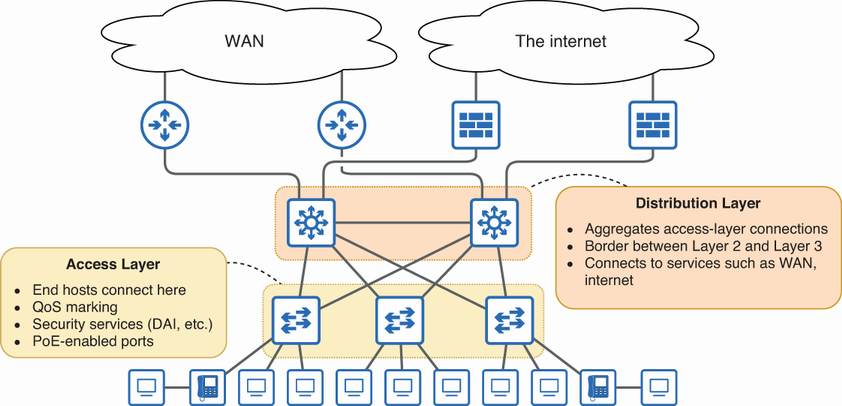
Use the topology figure to visualize access switches aggregated into a two-tier core-distribution design. section 15.2.1
