An IPv4 header is Layer 3 data added to a message so routers can deliver an IPv4 packet end to end. It carries source and destination addresses plus control information for handling the packet. section 4.3.2 section 7.0
Figure 7.1 The format of the IPv4 header. The header is typically 20 bytes in size (the minimum size) but can be up to 60 bytes if the Options field is used.
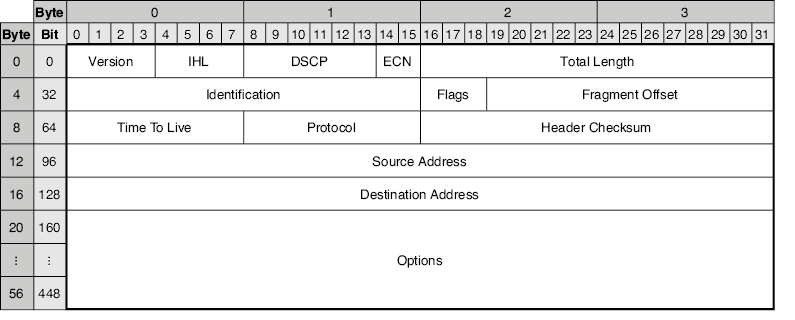
Use the header diagram to locate the fields from left to right and top to bottom. The minimum header is 20 bytes; optional Options can expand it to 60 bytes. section 7.1
The header contains 14 fields, although Options is optional. Its length is measured in 4-byte increments by the Internet Header Length (IHL) field. Count bits and bytes from zero when reading diagrams: bits 0–31 form the first 32-bit row. section 7.1 section 7.4
Use the fields for these delivery and control functions:
- Version identifies the IP version: binary 0100, or decimal 4, represents IPv4; 0110, or decimal 6, represents IPv6. section 7.1.1
- DSCP and ECN support traffic prioritization and congestion signaling as part of Quality of Service (QoS). section 7.4
- Total Length gives the entire packet size in bytes, while Identification, Flags, and Fragment Offset support fragmentation when a packet exceeds an interface’s MTU. section 7.4
- TTL prevents indefinite loops by decreasing by one at every router; a packet reaching zero is dropped. section 7.4
- Protocol identifies the encapsulated message, such as ICMP, TCP, UDP, or OSPF; Header Checksum checks for errors in the IPv4 header. section 7.4
- Source Address identifies the sending host, and Destination Address identifies the intended recipient. Options is variable, rarely used, and outside typical CCNA scope. section 7.4 section 7.1
When a packet is too large
If an IPv4 packet is larger than an interface’s 1500-byte standard MTU, the router can divide it into smaller fragments. Identification, Flags, and Fragment Offset allow those fragments to be handled as parts of the original packet. section 7.4
IPv4 headers travel with packets during Layer 3 delivery. At the destination, lower-layer information is removed first, then the IPv4 header is inspected and removed before the payload reaches the appropriate upper-layer protocol.
