liveBook · Manning

Destination address field

As explained in Acing the CCNA Exam: Volume 1 Fundamentals and Protocols

An IPv6 destination address field is a 128-bit IPv6 header field containing the destination IPv6 address of the packet.

The IPv6 destination address field is a 128-bit header field containing the IPv6 address of the packet’s intended recipient. It appears alongside the source address field near the end of the IPv6 header, after the Hop Limit field. section 20.3.1

Key points:

  • Use the destination address to identify where an IPv6 packet is going; the source address identifies where it came from. section 20.3.1
  • Distinguish this field from its IPv4 counterpart, which contains a 32-bit IPv4 address rather than a 128-bit IPv6 address. section 7.1.9 section 20.3.1
Figure 20.2 The format of the IPv6 header. The fields are Version, Traffic Class, Flow Label, Payload Length, Next Header, Hop Limit, Source Address, and Destination Address. The header is 40 bytes in size.
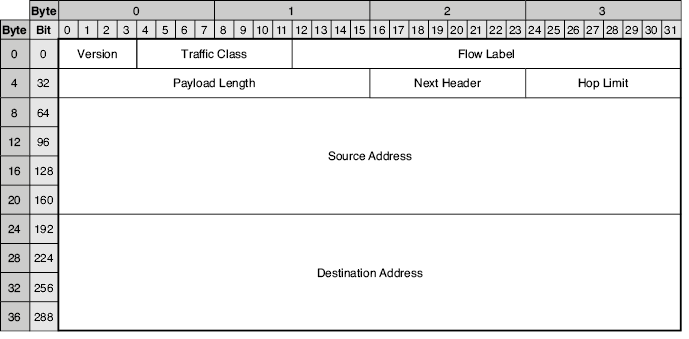
Use the IPv6 header diagram to locate the destination address field and compare it with the source address, Hop Limit, and other header fields. section 20.3.1

How Acing the CCNA Exam: Volume 1 Fundamentals and Protocols covers it

How deep it goes
Defines the field as 128 bits and locates it in the header, while deferring IPv6 address structure.
Examples
Uses an IPv6 header format diagram showing the destination address alongside the source address and Hop Limit.
What you can do after
Evaluate an IPv6 header diagram and identify its destination address field and recipient address.
How it connects
Connects IPv6 header, source address field, Hop Limit, and IPv6 address structure.

Related concepts

This explainer was generated by Manning's knowledge graph from the text of Acing the CCNA Exam: Volume 1 Fundamentals and Protocols. The section links point to the parts of the book it draws on.