liveBook · Manning

Differentiated services

As explained in Acing the CCNA Exam: Volume 2 Advanced Networking and Security

Differentiated Services is an IP packet-marking architecture that uses the DSCP field to classify traffic for differentiated forwarding treatment.

Differentiated Services (DiffServ) marks IP packets so network devices can classify traffic and provide differentiated forwarding treatment. IPv4 carries the marking in the DiffServ byte, while IPv6 uses the equivalent Traffic Class byte. section 10.3.3

Key operational facts:

  • DSCP occupies 6 bits, providing 64 possible values; ECN occupies the remaining 2 bits. section 10.3.3
  • DSCP markings remain with packets end to end unless another device changes them, unlike link-local PCP markings. section 10.3.3
  • Standard markings provide a shared QoS language across networks and vendors, including DF for best effort and EF for delay-sensitive traffic. section 10.3.3

Common DSCP values

DF (CS0) uses decimal value 0 for default best-effort traffic; EF uses 46 for voice traffic; CS1 uses 8 for low-priority or scavenger traffic. section 10.3.3

Figure 10.12 The old and current definitions of the ToS/DiffServ byte. The old ToS byte defined the 3-bit IPP field for QoS marking. The current DiffServ byte defines the six-bit DSCP field for QoS marking.
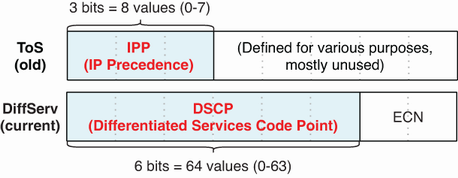
Compare the former three-bit IP Precedence layout with the current six-bit DSCP layout. section 10.3.3

How Acing the CCNA Exam: Volume 2 Advanced Networking and Security covers it

How deep it goes
Defines IPv4 and IPv6 fields, bit widths, persistence, and standard values, but does not provide configuration commands.
Examples
Uses DF, EF, CS1, voice traffic, best-effort traffic, scavenger traffic, and RFC 4594 traffic classes.
What it assumes
Assumes basic awareness of IPv4 and IPv6 headers while distinguishing current DSCP from legacy IP Precedence.
What you can do after
Evaluate packet markings and select standardized DSCP values for traffic classes.
How it connects
Connects DSCP with QoS, IP Precedence, PCP, ECN, IPv4, IPv6, and forwarding treatment.

Related concepts

This explainer was generated by Manning's knowledge graph from the text of Acing the CCNA Exam: Volume 2 Advanced Networking and Security. The section links point to the parts of the book it draws on.