An asymmetric password-authenticated key exchange lets a user authenticate with a password without revealing the password to the server. The server stores password-derived authentication material instead of the password itself, reducing the damage from password database exposure. section 11.4 section 11.2.2
OPAQUE is the recommended asymmetric or augmented PAKE described here. It uses an oblivious pseudorandom function (OPRF), which lets the server compute a pseudorandom function over a blinded password without learning the password input. section 11.2.2
A simplified OPAQUE flow separates registration from login:
- Registration: the user creates a long-term key pair and sends the public key to the server, associated with the user’s identity. section 11.2.2
- The user runs the OPRF with the password to derive a strong symmetric key, then encrypts a backup of the key pair for storage on the server. section 11.2.2
- Login: the user retrieves the encrypted key pair, repeats the OPRF with the password, and uses the resulting symmetric key to decrypt it. section 11.2.2
- The recovered key material then supports a mutually authenticated key exchange or a signed challenge. section 11.2.2
Why the distinction matters
Passwords are convenient because users carry them in their heads, but weak or reused passwords make breaches costly. An asymmetric PAKE preserves password-based login while keeping the real password away from the server; single sign-on and password managers address different parts of the password problem. section 11.2.2 section 11.4
Figure 11.4 An oblivious PRF (OPRF) is a construction that allows one party to compute a PRF over the input of another party without learning that input. To do this, Alice first generates a random blinding factor, then blinds her input with that before sending it to Bob. Bob uses his secret key to compute the PRF over the blinded value, then sends the blinded output to Alice who can unblind it. The result does not depend on the value of the blinding factor.
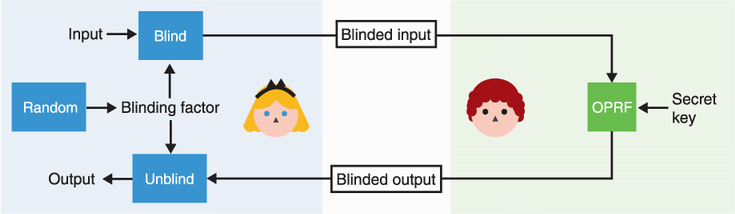
Use the OPRF diagram to see how blinding lets one party compute a PRF over another party’s input without learning that input. section 11.2.2
Figure 11.5 To register to a server using OPAQUE, Alice generates a long-term key pair and sends her public key to the server, which stores it and associates it with Alice’s identity. She then uses the OPRF protocol to obtain a strong symmetric key from her password and sends an encrypted backup of her key pair to the server. To log in, she obtains her encrypted key pair from the server, then performs the OPRF protocol with her password to obtain a symmetric key capable of decrypting her key pair. All that’s left is to perform a mutually authenticated key exchange (or possibly sign a challenge) with this key.
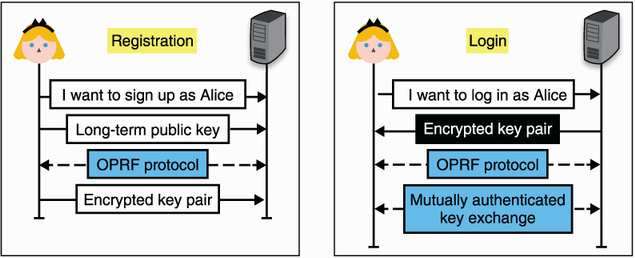
Use the OPAQUE flow diagram to follow key generation, encrypted key-pair storage, password-based recovery, and final mutual authentication. section 11.2.2
