Passwords are convenient but often weak, reused, and exposed by database breaches. OPAQUE lets a user authenticate to a known server without revealing the real password, using an asymmetric password-authenticated key exchange. section 11.4
The name comes from oblivious PAKE: an oblivious pseudorandom function (OPRF) helps turn the password into a strong symmetric key while keeping the password input hidden from the party holding the OPRF key. section 11.2.2
Figure 11.4 An oblivious PRF (OPRF) is a construction that allows one party to compute a PRF over the input of another party without learning that input. To do this, Alice first generates a random blinding factor, then blinds her input with that before sending it to Bob. Bob uses his secret key to compute the PRF over the blinded value, then sends the blinded output to Alice who can unblind it. The result does not depend on the value of the blinding factor.
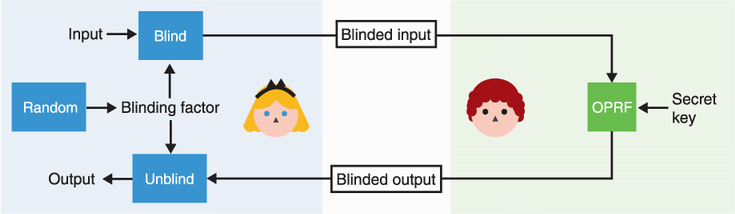
Follow the OPRF construction: one participant blinds an input, the other applies a keyed pseudorandom function without learning that input, and the first participant unblinds the result. section 11.2.2
