Asynchronous replication completes writes on the primary before confirming replication to the secondary. It avoids network-latency delays but permits limited data loss. section 13.1
Account for these operational consequences:
- Treat asynchronous replication as a disaster-recovery mechanism, not proof of zero data loss. section 13.1
- Monitor network and server performance because undersizing can create a synchronization queue. section 13.1
- Distinguish disaster recovery from high availability so the business does not overestimate its protection. section 13.1
Cross-site disaster recovery
An availability group replicates changes asynchronously to a secondary site. A primary write succeeds immediately, but a network delay or overloaded server can leave recent transactions unsynchronized when failure occurs. section 13.1
Figure 13.3 HA/DR topology using availability groups providing local automatic failover and cross- site manual failover
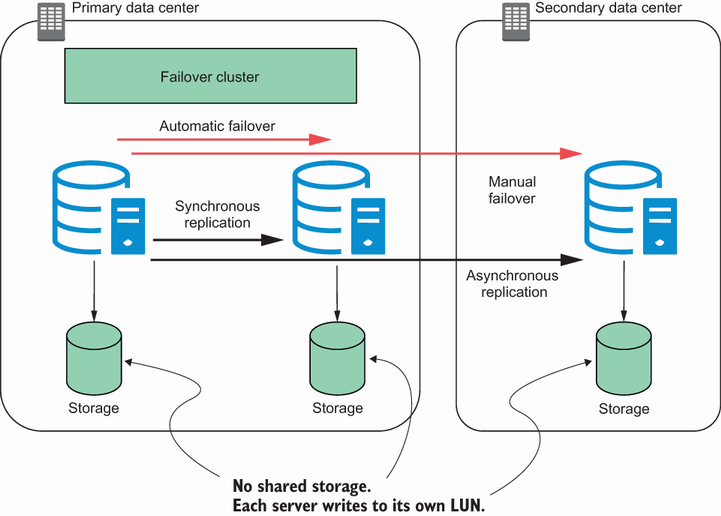
Use the HA/DR topology to compare local automatic failover with cross-site disaster-recovery replication. section 13.1
