Atrous spatial pyramid pooling (ASPP) is a multiscale context module used in DeepLabV3 segmentation. It applies parallel atrous convolutions at multiple rates and effective fields of view, capturing features at different scales without reducing image resolution. section 6.2
In document forgery detection, ASPP supports pixel-level analysis by:
- Capturing manipulated receipt regions that vary in size. section 6.2
- Supporting segmentation, where each image pixel is classified as forged or genuine. section 6.5
- Working alongside 1x1 convolutions that consolidate information across learned feature channels. section 6.2
Receipt forgery segmentation
A DeepLabV3 model can segment a receipt into forged and genuine pixels. ASPP helps the model recognize forgery artifacts across different spatial scales, while weighted cross-entropy addresses the scarcity of forged pixels. section 6.2 section 6.5
Figure 6.8 Architecture of the DeepLabV3 segmentation model that uses atrous convolution, 1x1 convolution, and atrous spatial pyramidal pooling as some distinct features that help in accurate image segmentation. (source: https://learnopencv.com/deeplabv3-ultimate-guide/)
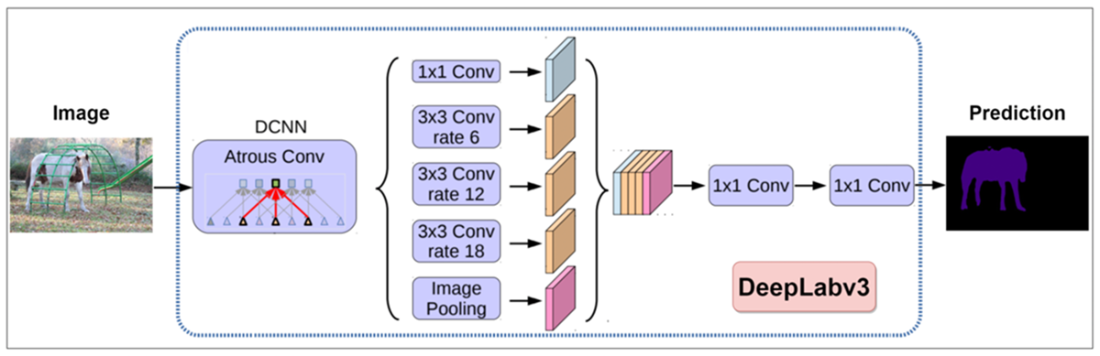
Use the DeepLabV3 architecture figure to locate ASPP alongside atrous and 1x1 convolution layers. section 6.2
