DeepLabV3 is a convolutional-neural-network architecture for pixel-wise image segmentation. In document forgery detection, it classifies each receipt pixel as genuine or forged, exposing manipulated regions instead of relying on language or opaque image-level predictions. section 6.2 section 6.5
Its distinctive components are atrous (dilated) convolutions, which enlarge the field of view without losing resolution; atrous spatial pyramid pooling (ASPP), which applies multiple rates and scales; and 1x1 convolutions, which consolidate channel information. section 6.2 section 6.5
Figure 6.8 Architecture of the DeepLabV3 segmentation model that uses atrous convolution, 1x1 convolution, and atrous spatial pyramidal pooling as some distinct features that help in accurate image segmentation. (source: https://learnopencv.com/deeplabv3-ultimate-guide/)
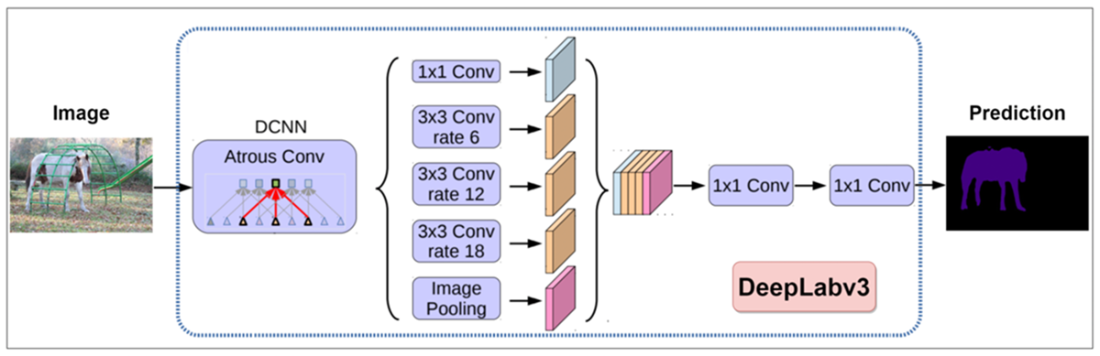
Use the architecture diagram to trace atrous convolution, 1x1 convolution, and atrous spatial pyramid pooling through the segmentation model. section 6.2
A practical DeepLabV3 forgery-detection workflow is:
- Convert the receipt images and pixel labels into a PyTorch Dataset. section 6.3
- Create a DataLoader for batching, shuffling, and parallel data loading. section 6.3
- Load a two-class DeepLabV3 model through torchvision and select a CPU or GPU device. section 6.3 section 6.3.2
- Train with weighted cross-entropy, monitor validation performance, evaluate on a blind test set, and interpret pixel-level predictions. section 6.3 section 6.3.2
Receipt forgery and class imbalance
Forged regions occupy only a small fraction of a receipt, so forged pixels are rarer than genuine pixels. Inverse-frequency class weights increase the penalty for missed forged pixels; excessively high weights can instead encourage predicting every pixel as forged. section 6.3.2 section 6.5
