A verifier can stop a prover from preparing a fake answer by adding an unpredictable question. In an interactive proof, this verifier-generated random value is the authentication challenge: it constrains the prover’s response and helps establish knowledge of a hidden witness. section 7.2.1
A challenge-based identification exchange follows this pattern:
- The prover commits to random value k before seeing the verifier’s randomness. section 7.2.1
- The verifier generates random value c and sends it as the challenge. section 7.2.1
- The prover uses k and c to compute the response s; without c, a prover lacking the witness cannot complete the final step. section 7.2.1
Why the question matters
In the Schnorr identification protocol, Peggy first commits to k, then Victor sends c. This prevents Peggy from choosing an answer based on an inverse or other shortcut after seeing the verification target. section 7.2.1
Figure 7.6 The Schnorr identification protocol is an interactive ZKP that is complete (Peggy can prove she knows some witness), sound (Peggy cannot prove anything if she doesn’t know the witness), and zero-knowledge (Victor learns nothing about the witness).
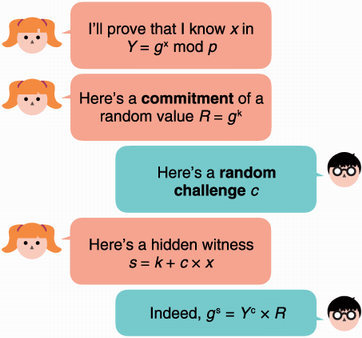
Use the protocol diagram to connect the challenge with completeness, soundness, and zero-knowledge. section 7.2.1

