An authoritative DNS server holds the definitive set of records for a specific domain and provides definite answers about that domain. It differs from a recursive resolver such as 8.8.8.8, which queries root, TLD, and authoritative servers on a client’s behalf. section 3.1.4 section 3.3
Understand its role in DNS resolution:
- Receives an iterative query after a root server and TLD server provide referrals. section 3.1.4
- Returns the definitive records for the requested domain to the recursive resolver. section 3.1.4
- Appears in the domain’s NS records, which identify its authoritative DNS servers. section 3.1.5
- May provide A, AAAA, CNAME, MX, PTR, and SOA records, not only IP addresses. section 3.3
Resolving mail.google.com
PC1 sends a recursive query to 8.8.8.8. The resolver queries a root server, follows its referral to the com TLD server, follows the TLD referral to Google’s authoritative DNS server, and returns the resulting IP address to PC1. section 3.1.4
Figure 3.4 Recursive and iterative DNS requests resolve a domain name. In step 1, PC1 attempts to access mail.google.com. Steps 2 and 9 are a recursive DNS exchange between PC1 and the 8.8.8.8 DNS server. Steps 3 through 8 are iterative DNS exchanges between 8.8.8.8 and other DNS servers. Step 10 is an HTTPS exchange between PC1 and mail.google.com.
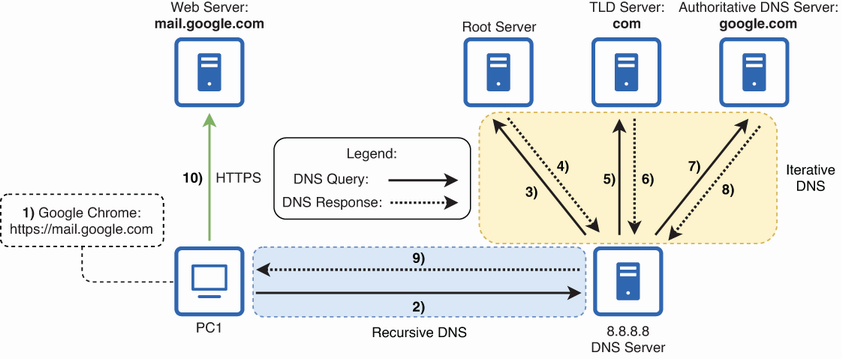
Trace the complete exchange, distinguishing the client-to-resolver recursive query from the resolver’s iterative queries and the final HTTPS connection. section 3.1.4
