An autocratic leadership style places one person in control of a decision. That person holds the decision rights and responsibility for allocating resources after choosing an alternative. Others are not involved or consulted, or are consulted only minimally. The style is strongly top-down: for example, an architect makes architectural design decisions and hands them to a development team for implementation. section 9.2.1
Autocracy is not simply a matter of who has formal authority. Democratic and autocratic decisions both retain a single decision-maker; the difference is whether that person defers the decision right to a group. Choosing the style consciously matters because decision-making processes shape software design and its sociotechnical effects. section 9.2 section 9.2.1
Use an autocratic style deliberately and communicate its boundaries clearly:
- Decide first whether the situation calls for an autocratic or democratic approach, and state why that approach fits. section 9.2.2
- Make the expected level of buy-in explicit: autocratic decisions are primarily commands and information about an already-made decision, rather than open requests for input. section 9.2.2
- Align communication with the actual decision style so people understand their role and influence; misalignment creates confusion, frustration, conflict, and resistance. section 9.2.1
- Connect a proposal to needs already known in the group, and leave room to adjust if an unspoken need or disagreement emerges. section 9.3.1
Redirecting a design session
A group is preparing to use Example Mapping and later domain message flow modeling. When concern arises that communication between bounded contexts may become too complex, facilitators propose doing domain message flow modeling next and postponing Example Mapping. The move is autocratic because it redirects the agenda, yet the proposal addresses the concern, includes known needs, and asks whether anyone disagrees or needs further support. With no objections, the group proceeds. section 9.3.1
Autocratic decisions tend to create little buy-in because people are informed after one person decides rather than invited to shape the choice. Low buy-in need not mean disregard for the group: a directive can still draw on group wisdom and respond to participants’ needs. Ambiguity is the greater risk—presenting a settled decision as a mere suggestion can foster resentment and resistance. section 9.2.2 section 9.3.1
Keeping a polarity from derailing the goal
Facilitators mapping a value chain choose not to revisit underlying user needs because the immediate goal is identifying streamlets for team ownership. Some participants want to go deeper, while others see that as lost time. When a polarity affects the session goal, make an autocratic proposal that connects all relevant needs; then use the group’s responses to determine whether adjustment is needed. section 10.3.2 section 10.5
Figure 9.4 Levels of buy-in plotted on the spectrum of democratic and autocratic decision-making styles
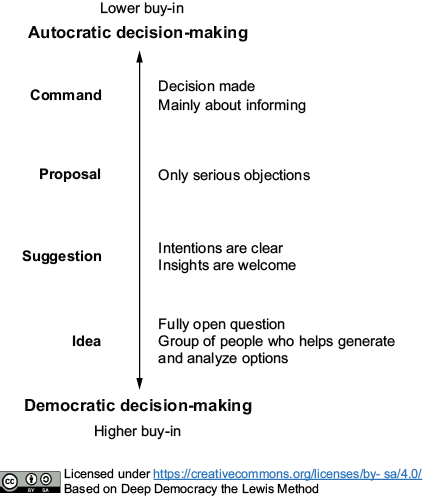
Use the spectrum to discuss how decision style relates to levels of buy-in, while avoiding the assumption that either style maps to one fixed level. section 9.2.2

