AutoGen is an open-source, conversational multi-agent platform for building applications where multiple AI agents collaborate through natural-language communication. It includes AutoGen Studio, a development environment for creating, testing, and managing multi-agent systems. section 4.0 section 4.1
AutoGen supports several collaboration patterns:
- Proxy communication uses a UserProxyAgent to receive human direction, coordinate assistant agents, review results, and provide feedback. section 4.1
- Group chat lets multiple agents share a conversation, review prior messages, and collaborate on longer or more complex tasks. section 4.3
- Hierarchical and other conversational patterns organize communication differently, while preserving natural-language interaction. section 4.1
A coding task with a proxy and assistant
Install pyautogen, configure OAI_CONFIG_LIST, and create a ConversableAgent alongside a UserProxyAgent. The proxy initiates a request such as “write a solution for fizz buzz in one line,” receives the assistant’s code, runs it, and continues until a termination message appears. Similar exercises generate a prime-number function or a Pygame game. section 4.2.1
Critiquing code in a group chat
A user proxy, engineer, and critic share a GroupChat managed by GroupChatManager. For a Pygame task, the engineer writes code, the critic suggests improvements, and the proxy participates in the conversation. This improves collaboration but increases verbosity and token consumption. section 4.3
Figure 4.2 The user proxy agent and assistant agent communication (Source: AutoGen)
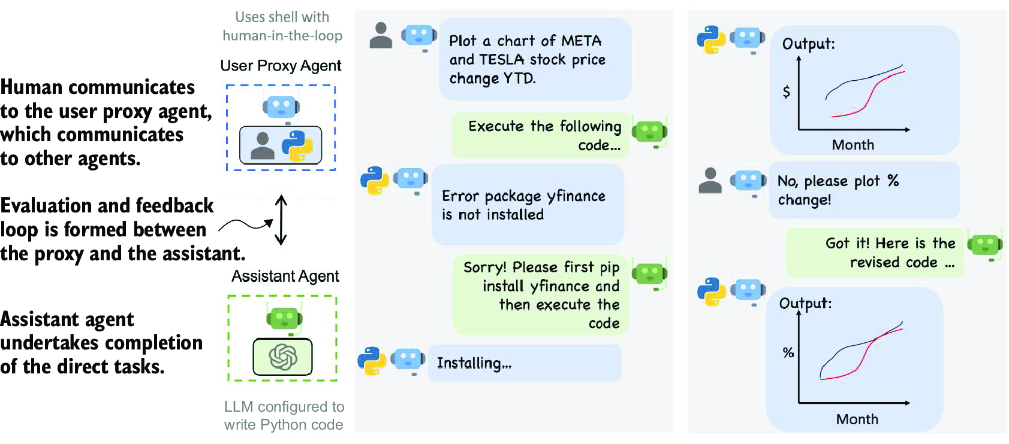
Shows how a user proxy directs an assistant agent and reviews its responses. section 4.1
