Automation bias is the tendency to over-trust and uncritically accept automated output, even when human expertise suggests that it may be wrong. In AI-assisted engineering, it turns a helpful assistant into a potential single point of failure: code ships because the machine produced it, not because anyone verified it. section 1.3
The hidden cost is trust debt: the deferred interest on code that entered a system without verification. The immediate saving belongs to the person moving quickly; the later cost is collective, invisible, and often paid by experienced engineers who must reconstruct intent and repair failures. section 1.3 section 1.8
Counter automation bias with disciplined engineering controls:
- Write a human-authored executable specification—such as tests, contracts, or acceptance criteria—before generating implementation. section 1.8
- Replace dump-and-review with verify-then-merge, keeping human attention at the point where correctness is decided. section 1.8
- Separate mechanical verification from semantic verification: types and tests can accelerate, but business meaning, edge cases, architecture, security, and performance still require judgment. section 1.8
- Increase autonomy gradually; higher leverage demands tighter verification, governance, and discipline. section 1.8
From generated code to owned code
A reliable workflow moves from open-ended exploration to specification, task execution, verification, refactoring, and team ownership. This is TDD applied at a larger scale: Specify, Implement, Verify. The model may handle scaffolding and boilerplate, while engineers validate the difficult remainder. section 1.3 section 1.8
Figure 1.1 The vibe engineering loop carries a feature from open-ended exploration through an executable specification and an iterating verification gate to tested, team-owned code.
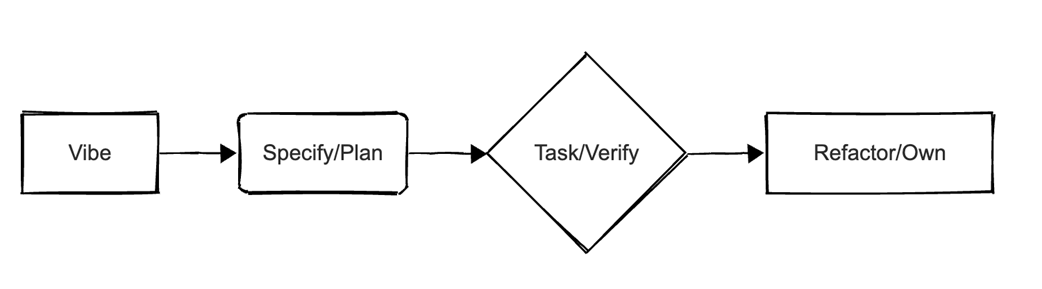
Use the loop diagram to trace how open-ended AI assistance becomes an executable specification, passes an iterating verification gate, and reaches tested, team-owned code. section 1.3



