A fraud agent can freeze accounts in seconds, but API credentials alone do not establish its authority to do so. An autonomy boundary defines where an agent may make decisions and where its authority ends. Beyond that point, the flow may need to pause and transfer control to a person; other limits may require a halt or narrower action. section 1.1 section 2.1.5
Unlike automation that executes predefined steps, bounded autonomy permits decisions within a governed space. A boundary constrains where the agent’s reasoning may be applied, not how it reasons. Hard limits cannot be crossed; soft thresholds trigger closer scrutiny. section 1.8 section 2.2.1
Fraud response: define the handoff
A credential-compromise agent might be authorized to freeze accounts for up to N customers. Above that threshold, it must obtain human sign-off. The design should also name the accountable owner and specify escalation conditions; otherwise, the system may be technically empowered to act without a documented authority chain. section 1.5.1 section 1.1
Make the boundary enforceable at runtime. Policy checks evaluate intended actions, observability sensors track decision patterns and proximity to limits, and escalation triggers return authority when the agent exceeds its permitted scope. Accountability remains with a named business owner even when execution shifts between agent and human. section 2.2.1 section 4.6
Figure 2.2 Architecture as runtime supervision. The diagram shows four components working as a continuous control loop. Observability sensors detect drift in the agent's behavior. The autonomous decision space is where agent actions occur, constrained by the autonomy boundary. The governance engine evaluates policy against intended actions before those actions execute and adjusts the decision space over time as conditions change. Together, these components supervise delegated authority rather than intervening in individual decisions.
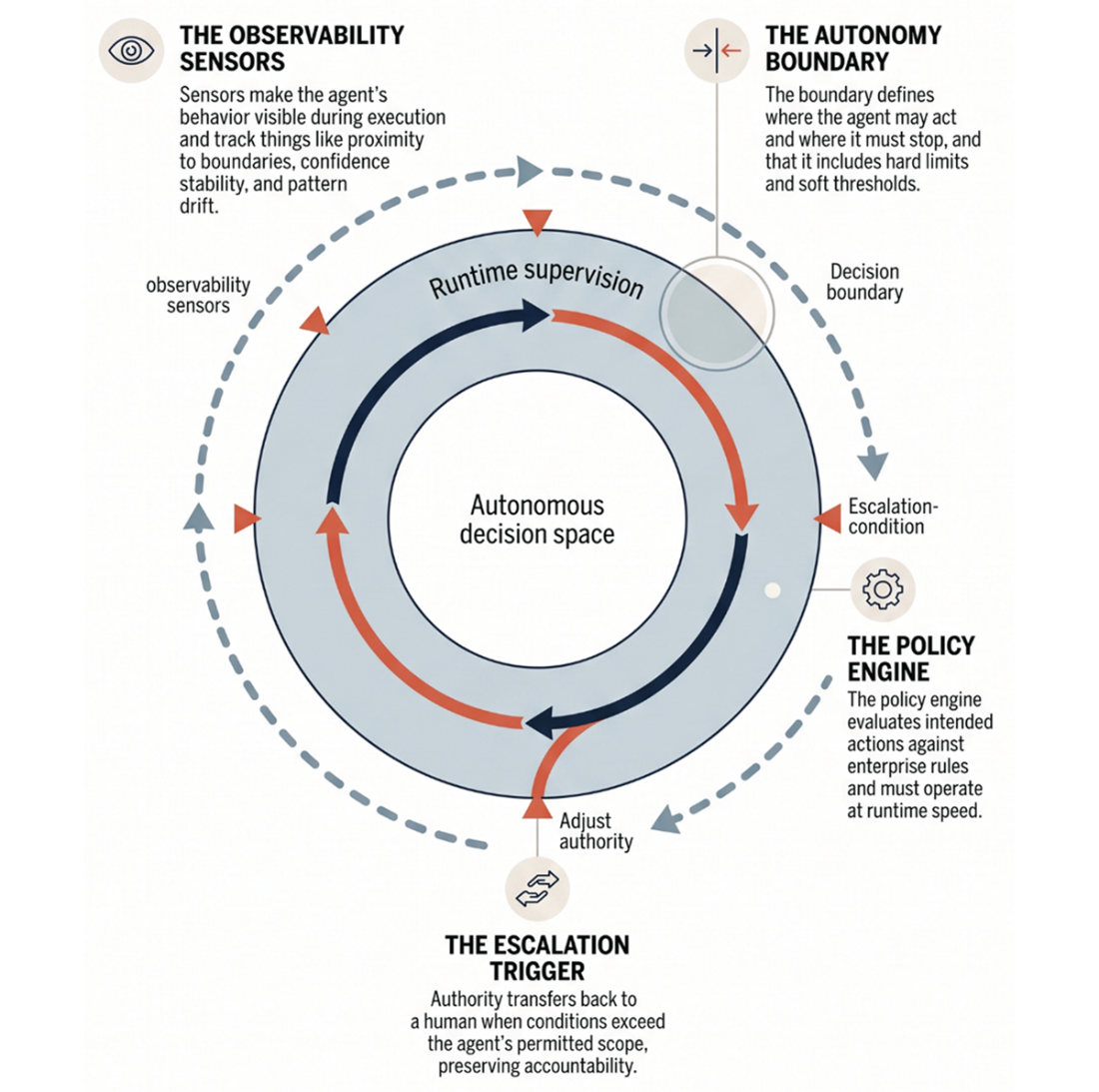
The supervision loop shows how boundaries, observability, and policy evaluation work together during operation. section 2.2.1
Manufacturing: an externally checked override
A material-flow agent proposes a robot schedule override for a priority component. An external policy service checks the priority flag, deadline, agent authority, and shift override limit. An allowed override is executed and logged with the policy version and outcome. If policy evaluation is unavailable, the request goes to a supervisor; if no supervisor responds within the permitted window, it is denied. section 1.5
Design the transfer and its ongoing stewardship explicitly:
- Specify the trigger, receiving actor, decision context, and authority needed to act. Define what happens if transfer is delayed or fails. section 2.1.5
- Allocate escalation ownership and response capacity. An unowned queue or a recipient without resolution authority can turn a boundary into deadlock. section 4.5.1
- Review decision patterns, escalation volumes, policy changes, and shifts in risk or context. Record approved changes so operational thresholds and architecture records remain aligned. section 2.1.6 section 4.3
