An auxiliary loss is an additional training signal computed from an intermediate network output. In GoogLeNet, intermediate Inception modules feed auxiliary classifiers: softmax produces predictions, and each classifier’s loss is computed against the ground truth. The final objective is a weighted sum of the auxiliary loss and the real loss, helping prevent the middle of a deep network from dying under vanishing gradients. section 11.2.2
The technique connects three architectural and optimization choices:
- Attach two auxiliary classifiers to intermediate Inception modules. section 11.2.2
- Compare each intermediate prediction with the ground truth after applying softmax. section 11.2.2
- Combine auxiliary and real losses through a weighted sum. section 11.2.2
Figure 11.8 Inception_v1 architecture
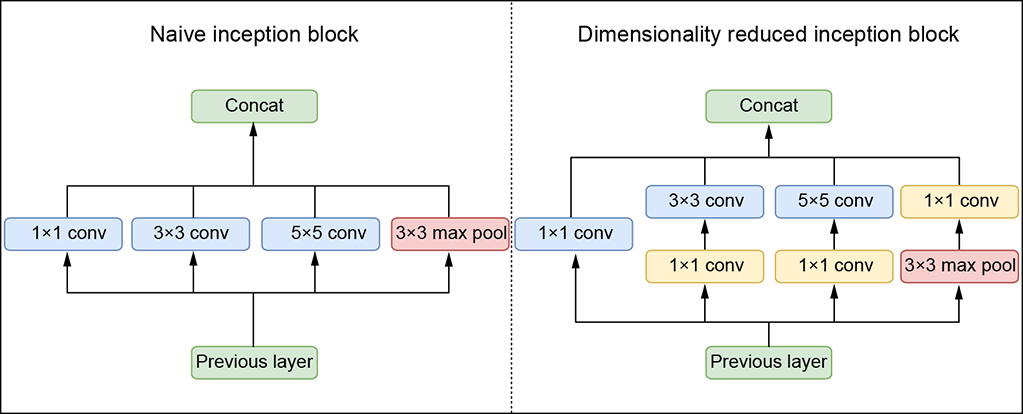
Use the Inception_v1 architecture diagram to locate intermediate classifier outputs and distinguish them from the final prediction path. section 11.2.2
