liveBook · Manning

Concealed modeling

As explained in Collaborative Software Design: How to facilitate domain modeling decisions

The named negative state produced by remaining too long in either detailed modeling or end-to-end modeling.

Concealed modeling names the negative state that appears when a team stays too long in either detailed modeling or end-to-end modeling. Detailed modeling answers questions and assumptions; end-to-end modeling exposes them at a high level. Either pole becomes harmful when pursued without balancing the other. section 10.2.1

Use the polarity map to make the downside visible and move toward balance:

  • Name the two poles, such as EventStorm deep versus wide. section 10.2.1
  • Fill the four quadrants with the positive and negative effects of each pole; begin with negative effects if the group needs the easiest route. section 10.2.1
  • Notice when one downside is growing, then take action toward the opposite pole’s upside. section 10.2.1
Figure 10.3 The filled-in quadrants of the polarity map. After filling this in, we have a better understanding of the positive and negative effects of the Deep versus Wide polarity.
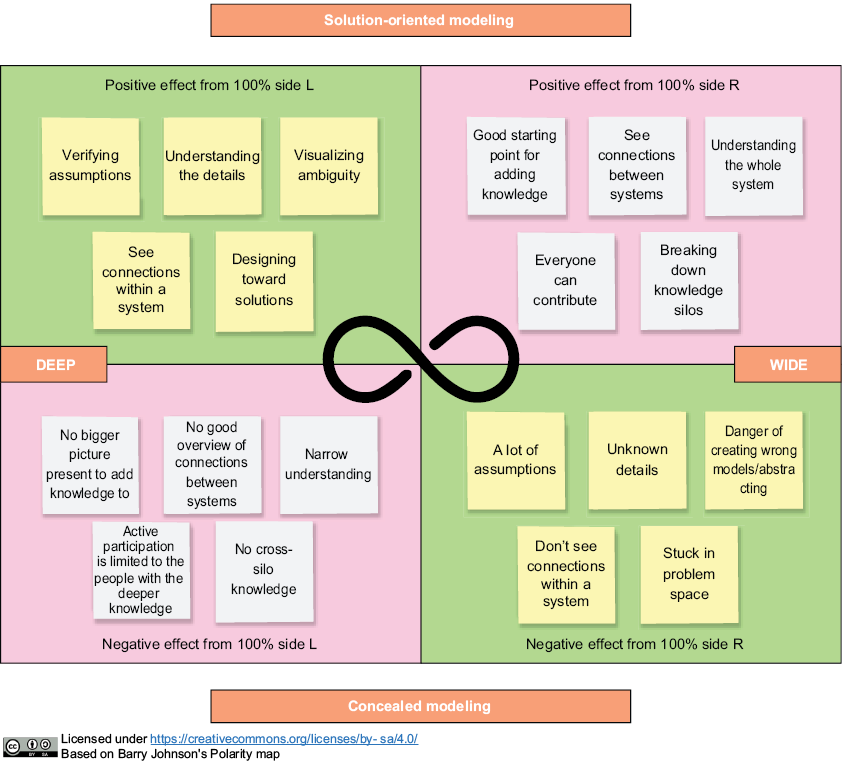
Use the filled polarity map to compare the upsides and downsides of deep and wide modeling and identify concealed modeling. section 10.2.1

How Collaborative Software Design: How to facilitate domain modeling decisions covers it

How deep it goes
Defines the negative state, explains its opposing effects, and outlines quadrant-filling and corrective actions.
Examples
Uses EventStorm deep-versus-wide modeling, four polarity quadrants, and an infinity symbol as concrete teaching artifacts.
What it assumes
Assumes familiarity with detailed and end-to-end modeling while defining how their effects interact.
What you can do after
Apply it via a polarity map to expose modeling downsides and choose movement toward the other pole’s upside.
How it connects
Connects polarity mapping, deep and wide modeling, and solution-oriented modeling.

Related concepts

This explainer was generated by Manning's knowledge graph from the text of Collaborative Software Design: How to facilitate domain modeling decisions. The section links point to the parts of the book it draws on.