Deep versus Wide frames detailed modeling and end-to-end modeling as complementary poles rather than mutually exclusive choices. Staying too long in either pole hides the benefits and exposes only the other pole’s downsides. section 10.2.1
Use a polarity map to restore shared understanding:
- Place Deep and Wide on opposite sides; the choice of left or right is arbitrary. section 10.2.1
- Fill four quadrants: Deep upside, Deep downside, Wide upside, and Wide downside. section 10.2.1
- Think in extremes by asking what happens when modeling only in detail or only end to end. section 10.2.1
- Start with negative effects, or begin with the minority’s pole when group dynamics make that easier. section 10.2.1
Balancing both poles
End-to-end modeling exposes questions and assumptions; detailed modeling supplies answers. A balanced polarity seeks the positive effects of both, described here as Solution-Oriented Modeling, while avoiding Concealed Modeling. section 10.2.1
Figure 10.2 The four quadrants of a polarity map, representing the positive and negative effects of each pole. An alternative way to talk about positive and negative effects of a pole are the upside and downside of that pole.
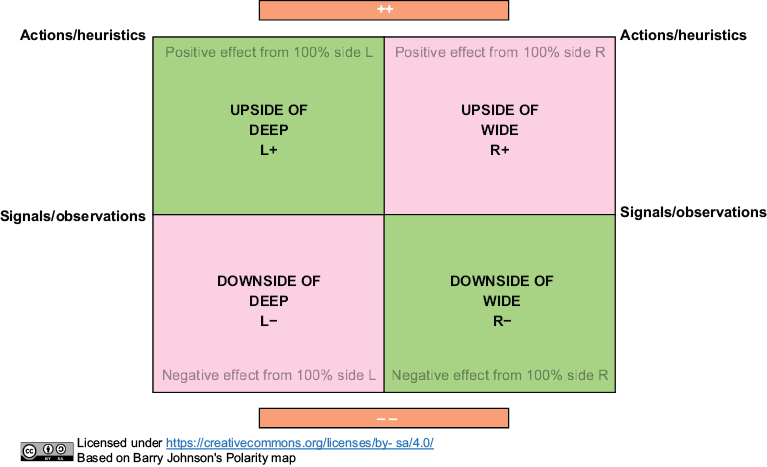
The four-quadrant polarity map makes each pole’s upside and downside visible for group discussion. section 10.2.1
