Solution-oriented modeling is the positive state created by balancing detailed modeling with end-to-end modeling. Deep modeling answers questions and tests assumptions; wide modeling reveals the whole flow but can leave questions unresolved. The goal is to gain both benefits without staying too long in either pole’s downside. section 10.2.1
Use a polarity map to make the balance discussable:
- Name the two poles, such as EventStorming Deep versus Wide. section 10.2.1
- Fill four quadrants with the positive and negative effects of each pole, thinking in extremes. section 10.2.1
- Call the desired positive balance solution-oriented modeling and the negative result concealed modeling. section 10.2.1
- Rebalance when one pole’s downside becomes too strong, moving toward the other pole’s upside. section 10.2.1
Figure 10.3 The filled-in quadrants of the polarity map. After filling this in, we have a better understanding of the positive and negative effects of the Deep versus Wide polarity.
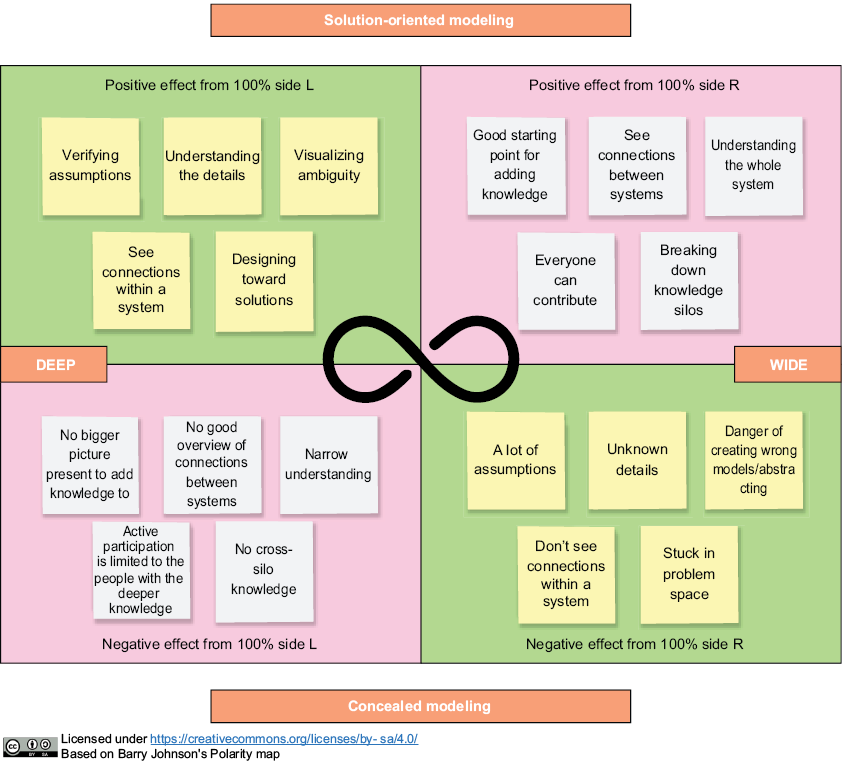
The filled polarity map makes the positive and negative effects of deep and wide modeling visible for group discussion. section 10.2.1
