A Backend for Frontend (BFF) is a lightweight backend service tailored to one client type or interface. Instead of making a mobile, web, or desktop client assemble a screen through several service calls, the BFF performs the orchestration and returns the exact combined response that client needs. section 5.3.4
The pattern targets round-trip latency. Five sequential calls from a mobile device over a cellular network accumulate delay at every hop; the BFF can make equivalent service calls within the data center and send one response back to the client. Separate BFFs also let client teams evolve their APIs without forcing one shared public API to compromise between conflicting web, mobile, and partner needs. section 5.3.4
Keep a BFF thin and focused on client-facing orchestration:
- Aggregate data from existing services and return a combined, client-specific payload. section 5.3.4
- Fetch independent service calls in parallel as the layer takes over orchestration. section 5.5.1
- Handle gateway concerns such as rate limiting, authentication, and cache control where appropriate. section 5.3.4
- Introduce the layer without changing the APIs it aggregates when an independent improvement is possible. section 5.5
Migrating away from sequential client calls
A strangler fig migration can begin with a BFF that only proxies requests to existing services. It can then aggregate calls, fetch multiple services in parallel, and return one response while the frontend switches to the BFF. Old APIs remain available until the new path has taken over gradually. section 5.5.1
Use performance targets to decide whether the added layer is worthwhile. For example, reducing page load time from four seconds to under two may justify aggregating API calls. During longer migrations, account for the cost of running old and new systems together, including synchronization, routing, and maintaining expertise in both. section 5.5.2
Figure 5.8 Architectural improvement decision tree. If you can improve one piece without touching others, prefer incremental changes like caching or query optimization, which are lower risk and deliver quick wins. If every change forces coordinated modifications across the system, larger architectural changes become necessary despite longer timelines and coexistence costs.
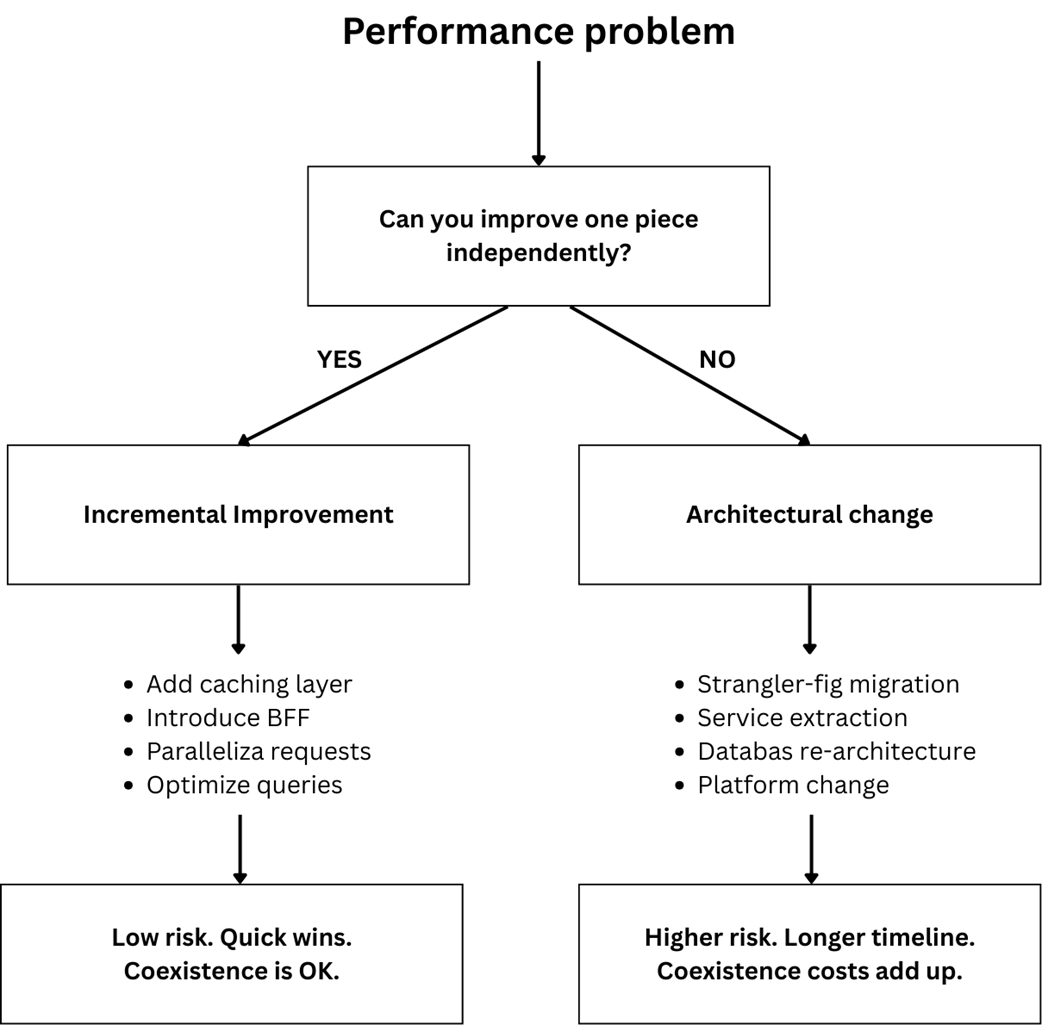
Use the decision tree to distinguish a low-risk independent improvement from a structural change that requires coordinated architectural work. A BFF is a candidate when reducing network hops cannot be solved by isolated tactical fixes. section 5.5





