liveBook · Manning

Background processing

As explained in Acing the Certified Kubernetes Administrator Exam, Second Edition

A Linux background process is an operating-system process that runs without directly occupying an interactive terminal.

A Linux background process runs without directly occupying an interactive terminal. In Kubernetes, such host processes help keep the cluster running, while DaemonSets provide similar per-node behavior through pods. section 1.8 section 1.10

Separate host-managed processes from DaemonSet-managed components:

  • kube-proxy and CNI components can run as DaemonSets, maintaining a pod on each node. section 1.8
  • kubelet runs directly as a Linux background process on the node rather than as a DaemonSet. section 1.8
  • Inspect DaemonSets with kubectl get ds -A and inspect kubelet's systemd entry with sudo systemctl list-unit-files --type service | grep kubelet -A3 -B3. section 1.8

Checking kubelet

The systemd listing identifies kubelet.service and its enabled state. If the process is stopped, start it with systemctl start kubelet; use the service state as a node-repair clue. section 1.8

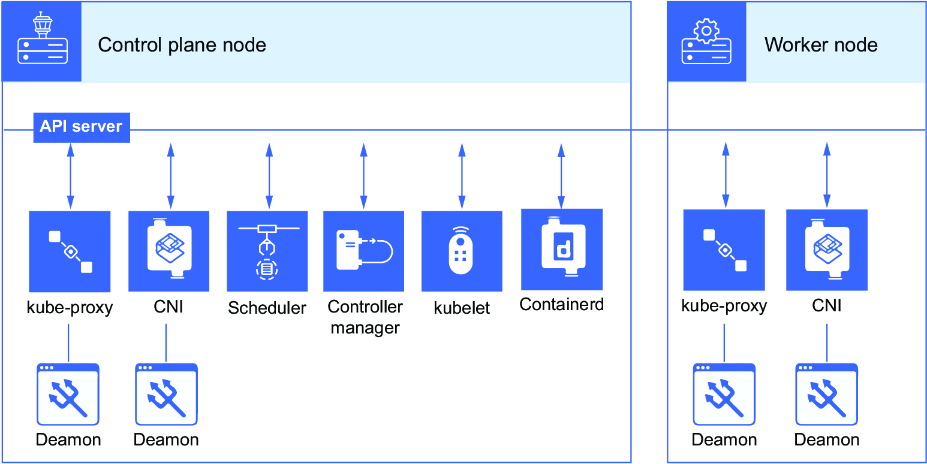
Figure 1.13 DaemonSets ensure that a single pod is running on each node in the cluster. kube-proxy and CNI both run as a DaemonSet.
figure

Use the node diagram to contrast DaemonSet pods with host-level kubelet processing. section 1.8

How Acing the Certified Kubernetes Administrator Exam, Second Edition covers it

How deep it goes
Explains the distinction, verification commands, and a kubelet start operation, but does not develop Linux process internals.
Examples
Shows kube-proxy and CNI DaemonSets, kubectl get ds -A output, and kubelet.service systemd inspection.
What it assumes
Requires recognizing Kubernetes nodes, DaemonSets, kubectl, and Linux systemd service listings.
What you can do after
Operate and diagnose kubelet by inspecting its systemd state and starting it when stopped.
How it connects
Connects background processes with daemons, systemd services, DaemonSets, kubelet, kube-proxy, CNI, and Kubernetes nodes.

Also explained in

Compare how 4 books explain background processing →

Related concepts

This explainer was generated by Manning's knowledge graph from the text of Acing the Certified Kubernetes Administrator Exam, Second Edition. The section links point to the parts of the book it draws on.


