An OS thread is a unit of processing scheduled by the operating system. Threads can run concurrently, with overlapping execution, or in parallel, performing the same task at once. Switching a CPU core between threads requires saving execution state, so context switching is costly. Here, “thread” means an execution unit, not a logical CPU core. section 8.2.1
Go developers create goroutines, not OS threads directly. The Go runtime schedules goroutines onto OS threads; goroutines use less memory and can be switched more quickly than OS threads. section 8.2.1
A worker pool on four cores
With four cores and four OS threads, a pool can still initially have only one goroutine running. Work stealing may let other threads run goroutines, but the timing is not guaranteed. For CPU-bound pools, GOMAXPROCS is a recommended sizing guide; for I/O-bound pools, consider the external system’s capacity. section 8.5
Figure 8.6 An example of the current state of a Go application executed on a four-core machine. Goroutines that aren’t in an executing state are either runnable (pending being executed) or waiting (pending a blocking operation).
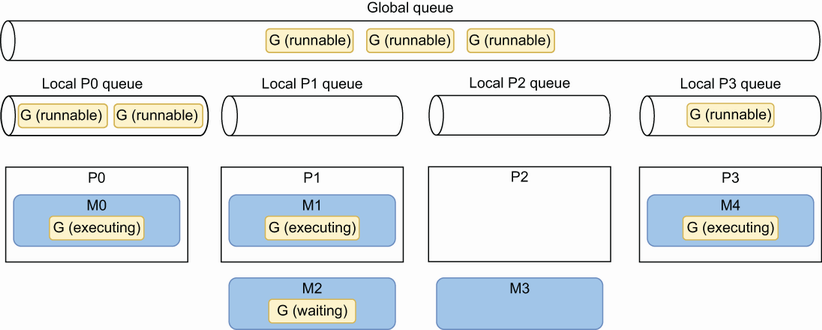
Visualizes goroutines running, runnable, or waiting in a Go application on a four-core machine. section 8.2.1











