Bagging, short for bootstrap aggregating, turns one unstable learner into a more robust ensemble. Rather than trust a single decision tree that may overfit or react strongly to outliers, train many copies on slightly different versions of the training data and combine their answers. The models use the same learning algorithm, but randomized samples give them useful diversity. section 2.2 section 2.2.2
Figure 2.2 Bagging, illustrated. Bagging uses bootstrap sampling to generate similar but not exactly identical subsets (observe the replicates here) from a single data set. Models are trained on each of these subsets, resulting in similar but not exactly identical base estimators. Given a test example, the individual base-estimator predictions are aggregated into a final ensemble prediction. Also observe that training examples may repeat in the replicated subsets; this is a consequence of bootstrap sampling.
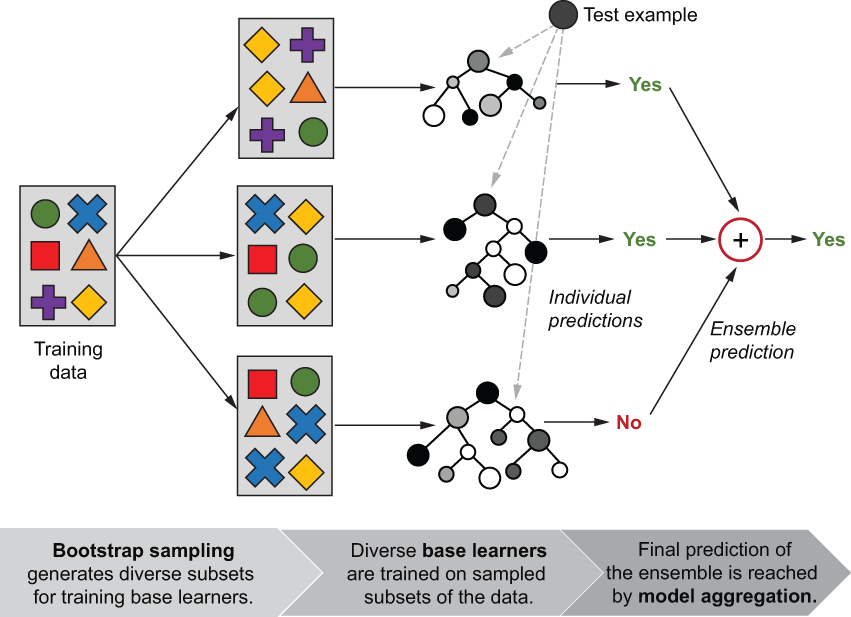
Use the diagram to follow the full flow: sample training examples with replacement, fit one base estimator per replicate, then aggregate their predictions for a test example. Repeated examples within a replicate are expected. section 2.2
Bagging has two independent stages:
- Create a bootstrap sample for each estimator by drawing training examples with replacement. Each replicate differs from the original and from the others, so the fitted estimators differ too. section 2.2 section 2.2.2
- Fit every base estimator independently. This makes the training work naturally parallelizable across CPU cores or other computing resources. section 2.2.2 section 2.2.4
- Aggregate predictions: use majority voting for classification and the mean for regression. Aggregation smooths individual mistakes into one ensemble prediction. section 2.2 section 7.2.1
Bagging is especially useful for complex, nonlinear, unstable estimators that overfit in different places when trained on different bootstrap samples. Aggregation reduces that variation and often produces smoother decision boundaries. It is less attractive when training many fully fitted models exceeds the available compute budget, although parallel execution can reduce elapsed training time. section 2.2.3 section 7.2.1
Bagged decision trees on noisy two-dimensional data
A simple implementation repeatedly samples rows, fits decision trees, and takes the mode of their class predictions. On a noisy two-dimensional data set, 500 depth-12 trees trained on bootstrap samples of 300 examples achieved 89.90% test accuracy, compared with 83.84% for one tree. In scikit-learn, BaggingClassifier exposes the base estimator, n_estimators, max_samples, oob_score, and n_jobs; out-of-bag accuracy estimates generalization using examples omitted from each tree’s bootstrap sample. section 2.2.2 section 2.2.3 section 2.2.4
Ensemble size and base-learner complexity are practical tuning questions. In a breast-cancer diagnosis experiment, training and test error decreased as the number of estimators grew, then test error stabilized; bagging, random forests, and Extra Trees all outperformed a single tree. Random forests extend bagging with randomized decision trees, while related variants change whether examples, features, or both are sampled. section 2.5.2 section 2.6



