liveBook · Manning

Bagging

As explained in Grokking Machine Learning

An ensemble technique that trains successive learners on random bootstrap subsets of data and aggregates their predictions.

Bagging, short for bootstrap aggregating, builds several learners on random samples drawn from a dataset with replacement, then combines their predictions. Classification uses a vote; regression uses an average. section 12.1 section 12.7

A bagging procedure:

  • Draw random subsets from the dataset with replacement; some points may appear in multiple subsets, while others may be left out. section 12.1
  • Train a separate learner on each subset, then combine their predictions by voting for classification or averaging for regression. section 12.1

Spam and ham emails

A random forest can combine decision trees trained on samples of emails described by counts of “lottery” and “sale.” In a manual illustration, three trees vote; a Scikit-Learn example fits a forest of five depth-1 trees. section 12.2

Figure 12.1 Ensemble methods consist of joining several weak learners to build a strong learner.
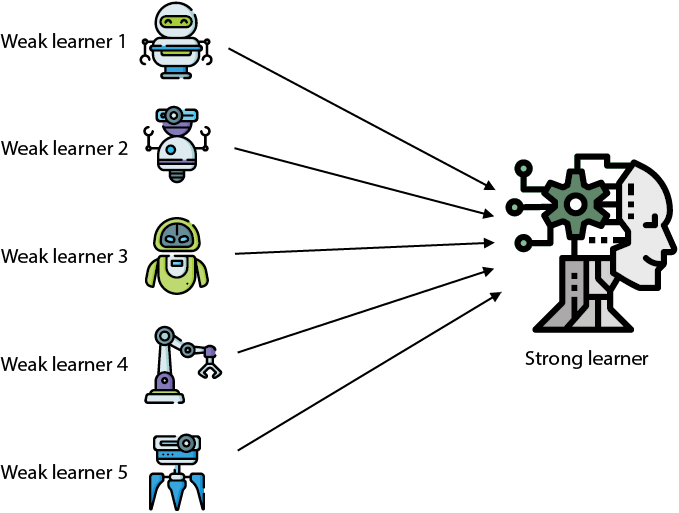
The figure illustrates how several weak learners combine into a strong learner. section 12.1


How Grokking Machine Learning covers it

How deep it goes
Defines bootstrap sampling and prediction aggregation, then works through a random-forest example without deriving theoretical guarantees.
Examples
Uses a friends’ voting analogy and a spam-email dataset with lottery and sale word counts.
What it assumes
Assumes familiarity with decision trees and introduces learner as another term for a machine-learning model.
What you can do after
Apply bagging via Scikit-Learn’s RandomForestClassifier to fit a forest and score its predictions.
How it connects
Connects bagging with ensemble learning, random forests, decision trees, boosting, classification, and regression.

Also explained in

Compare how 4 books explain bagging →

Related concepts

This explainer was generated by Manning's knowledge graph from the text of Grokking Machine Learning. The section links point to the parts of the book it draws on.

