A band is a defined range of frequencies. Wireless LANs use the 2.4 GHz, 5 GHz, and newer 6 GHz RF bands. section 18.2.2
Apply these distinctions when planning or evaluating wireless networks:
- The 2.4 GHz band spans 2.4–2.495 GHz, penetrates obstacles better, but is vulnerable to congestion from Bluetooth, microwaves, and other devices. section 18.2.2
- A channel is a smaller frequency range within a band; transmitting and receiving devices must use the same channel. section 18.2.2
- Overlapping 2.4 GHz channels require careful planning, commonly using 1-6-11 or 1-5-9-13 patterns. section 18.2.3
Exam application
When asked which standards require careful channel selection, identify standards using 2.4 GHz: 802.11b and 802.11g. section 18.2.3
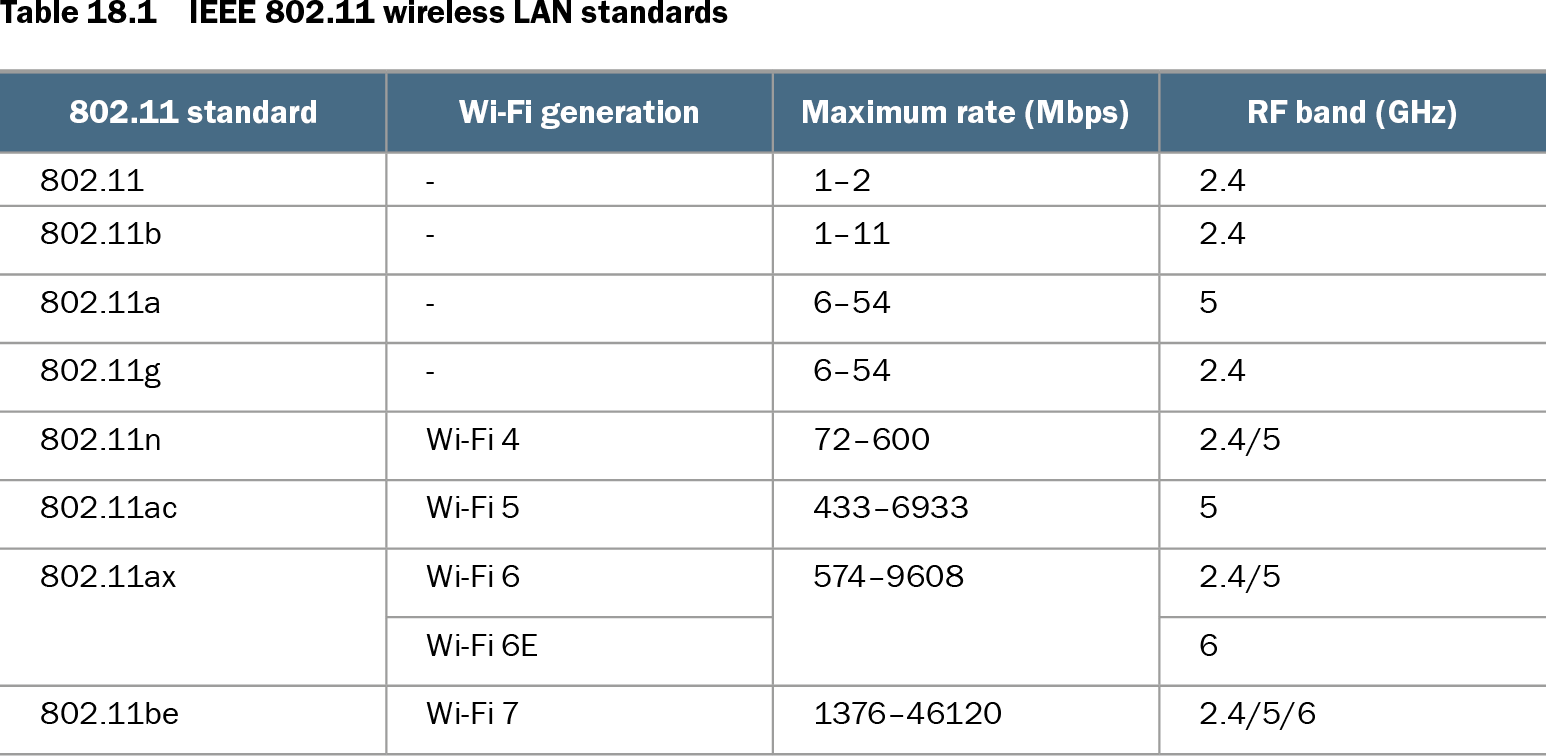
Table 18.1 IEEE 802.11 wireless LAN standards (view table figure)
| 802.11 standard |
Wi-Fi generation |
Maximum rate (Mbps) |
RF band (GHz) |
|---|---|---|---|
| 802.11 |
- |
1–2 |
2.4 |
| 802.11b |
- |
1–11 |
2.4 |
| 802.11a |
- |
6–54 |
5 |
| 802.11g |
- |
6–54 |
2.4 |
| 802.11n |
Wi-Fi 4 |
72–600 |
2.4/5 |
| 802.11ac |
Wi-Fi 5 |
433–6933 |
5 |
| 802.11ax |
Wi-Fi 6 |
574–9608 |
2.4/5 |
| Wi-Fi 6E |
6 |
||
| 802.11be |
Wi-Fi 7 |
1376–46120 |
2.4/5/6 |
Compare IEEE 802.11 standards with their RF bands, including dual-band and 6 GHz-capable generations. section 18.2.3