A wireless channel is a specific range of radio frequencies within a wireless band. Transmitting and receiving devices must use the same channel to communicate. section 18.2.2
Channel selection affects interference, especially in the 2.4 GHz band, where overlapping channels can make neighboring access points contend for airtime. section 18.2.2
Operational facts to remember:
- The 2.4 GHz band contains 14 channels, typically 20 MHz wide; older standards use 22 MHz. section 18.2.2
- Countries permit different channel ranges: channels 1–11 are common in the United States and Canada, while other regions may allow 1–13 or channel 14. section 18.2.2
- Use non-overlapping layouts such as channels 1, 6, and 11 to reduce interference among neighboring access points. section 18.2.2
- Combine 20 MHz channels into wider 40, 80, or 160 MHz channels in 5 GHz, and up to 320 MHz in 6 GHz, to support higher transfer rates. section 18.2.2
- All basic service sets provided by one access point use the radio’s same channel, so multiple BSSs do not eliminate congestion. section 18.3.2
Exam-style channel selection
When asked which standards require careful channel selection because of 2.4 GHz overlap, choose 802.11b and 802.11g. Both use the 2.4 GHz band. section 18.2.3
Figure 18.9 Channels in the 2.4 GHz band. There are 14 channels in total. Because many channels in the 2.4 GHz band overlap, channels 1, 6, and 11 should be used to avoid interference.

Visualizes the 14 channels in the 2.4 GHz band and highlights the recommended 1, 6, and 11 layout. section 18.2.2
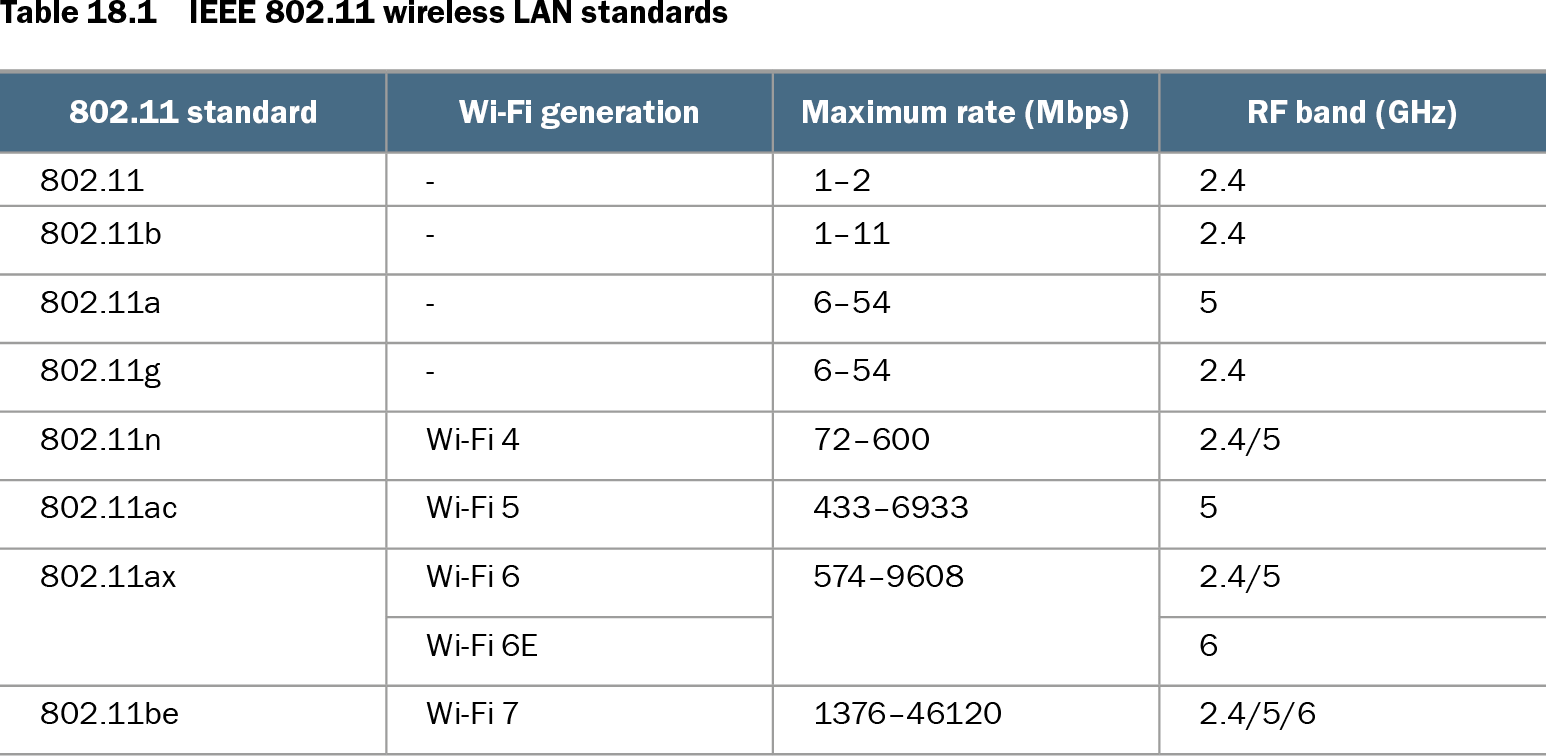
Table 18.1 IEEE 802.11 wireless LAN standards (view table figure)
| 802.11 standard |
Wi-Fi generation |
Maximum rate (Mbps) |
RF band (GHz) |
|---|---|---|---|
| 802.11 |
- |
1–2 |
2.4 |
| 802.11b |
- |
1–11 |
2.4 |
| 802.11a |
- |
6–54 |
5 |
| 802.11g |
- |
6–54 |
2.4 |
| 802.11n |
Wi-Fi 4 |
72–600 |
2.4/5 |
| 802.11ac |
Wi-Fi 5 |
433–6933 |
5 |
| 802.11ax |
Wi-Fi 6 |
574–9608 |
2.4/5 |
| Wi-Fi 6E |
6 |
||
| 802.11be |
Wi-Fi 7 |
1376–46120 |
2.4/5/6 |
Maps IEEE 802.11 standards to Wi-Fi generations, maximum rates, and RF bands. section 18.2.3