liveBook · Manning

Base station

As explained in Optimization Algorithms: AI techniques for design, planning, and control problems

A base station is a fixed wireless-network node that communicates with and provides services to mobile user equipment.

A base station is a fixed wireless-network node, or cell, that connects mobile user equipment (UE) and distributes limited resources among connected users. section 12.4

Base-station coordination balances competing goals: connecting a UE to more stations can increase data rate, while shared scheduling resources create competition and affect global quality of experience (QoE). section 12.4

Training a coordination policy

A small mobile network with three base stations and five users can train a PPO agent to choose UE-to-BS connections. The mobile-env environment exposes observations and rewards, while rendering shows the learned coordination. section 12.4

Figure 12.10 The mobile-env environment with a number of base stations and user equipment
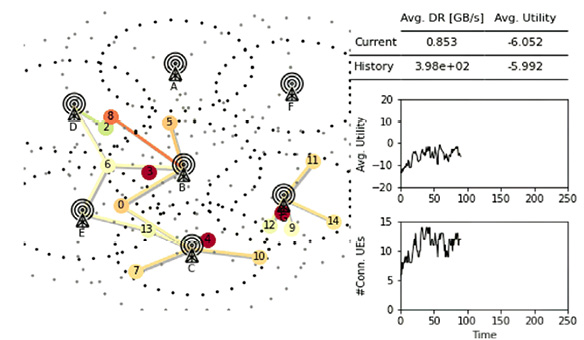
Visualize the mobile environment’s base stations, cells, and user equipment. section 12.4

How Optimization Algorithms: AI techniques for design, planning, and control problems covers it

How deep it goes
Explains connection trade-offs and demonstrates centralized and multi-agent PPO training, stopping short of physical radio internals.
Examples
Uses a three-base-station, five-user mobile-env scenario with centralized or multi-agent PPO.
What you can do after
Apply it via mobile-env and PPO to train, evaluate, and render connection policies.
How it connects
Connects base stations with user equipment, cells, data rate, signal-to-noise ratio, quality of experience, and reinforcement learning.

Related concepts

This explainer was generated by Manning's knowledge graph from the text of Optimization Algorithms: AI techniques for design, planning, and control problems. The section links point to the parts of the book it draws on.