A basic service set (BSS) is the fundamental 802.11 wireless LAN structure: wireless clients connect through one access point (AP), which coordinates communication and provides access to resources such as a wired LAN or the internet. section 18.3.2
Key BSS behavior and identifiers:
- Clients in the same BSS send frames through the AP rather than directly to one another, even when they are within radio range. section 18.3.2
- The AP’s coverage area is the basic service area (BSA), also called the cell. section 18.3.2
- The SSID is the human-readable network name; the BSSID uniquely identifies the BSS and is usually the AP radio’s MAC address. section 18.3.2
- One AP can provide multiple BSSs, but a single radio requires them to share its channel, so additional BSSs do not reduce channel congestion. section 18.3.2 section 18.5
- The distribution system connects BSSs to the wider network and commonly maps wireless SSIDs to VLANs on a wired Ethernet LAN. section 18.5
Single AP with three clients
An AP and three clients form one BSS on channel 1 of the 2.4 GHz band. If two clients need to exchange frames, both send through the AP, which relays the traffic to its destination. section 18.3.2
Figure 18.14 A BSS consisting of an AP and three clients. Clients cannot send frames directly to each other; they must communicate via the AP.
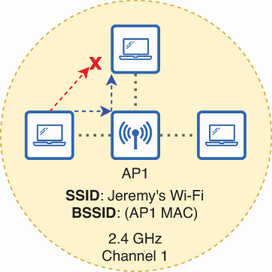
Visualizes the AP-centered topology and shows why clients in a BSS cannot communicate directly with each other. section 18.3.2
