IEEE 802.11 defines wireless LAN standards at TCP/IP Layers 1 and 2, specifying radio frequencies, signal encoding, frame formats, and wireless communication behavior over the air. section 18.1 section 19.1
Wi-Fi is the Wi-Fi Alliance trademark for equipment that passes interoperability certification against 802.11 requirements; IEEE does not use Wi-Fi as its official name. section 18.1
Recognize the major 802.11 generations and their radio-frequency bands:
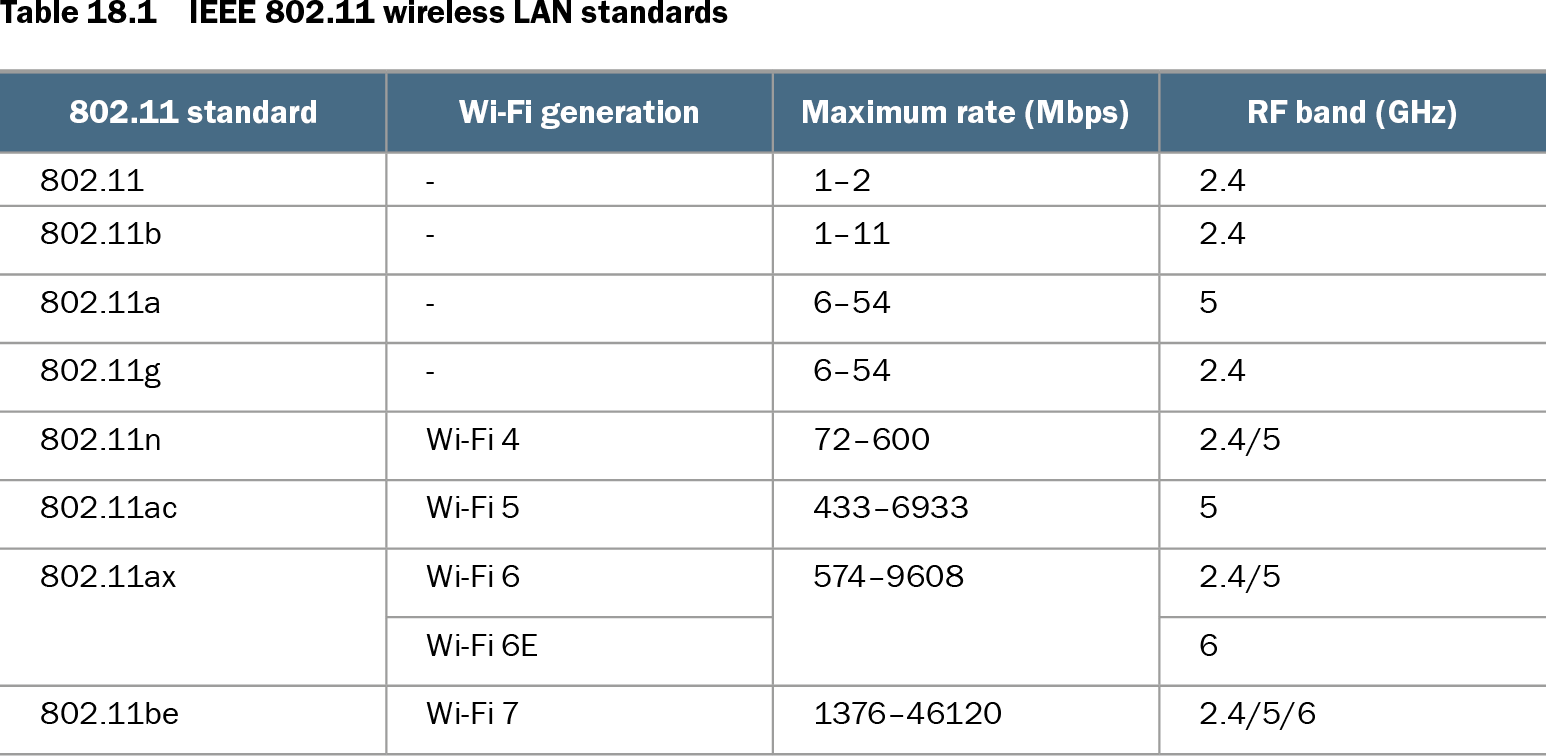
- 802.11 and 802.11b use 2.4 GHz; 802.11a uses 5 GHz; and 802.11g uses 2.4 GHz. section 18.2.3
- 802.11n, marketed as Wi-Fi 4, supports 2.4 and 5 GHz; 802.11ac, marketed as Wi-Fi 5, uses 5 GHz. section 18.2.3
- 802.11ax, marketed as Wi-Fi 6, supports 2.4 and 5 GHz; Wi-Fi 6E uses 6 GHz; 802.11be is Wi-Fi 7. section 18.2.3
- Treat listed transfer rates as theoretical maximums: real performance is lower because wireless conditions and external factors affect throughput. section 18.2.3
Channel-selection exam scenario
Neighboring access points require careful channel selection in the overlapping 2.4 GHz band. The 1-6-11 or 1-5-9-13 patterns reduce interference; among the listed choices, 802.11b and 802.11g use that band. section 18.2.3
802.11 uses its own frame format and message types. Management frames establish and maintain communication, control frames coordinate delivery, and data frames carry client traffic. section 19.1 section 19.3
Clients discover access points through active scanning with probe requests and responses or passive scanning with beacons, then authenticate and associate before exchanging traffic. section 19.3
Table 18.1 IEEE 802.11 wireless LAN standards (view table figure)
| 802.11 standard |
Wi-Fi generation |
Maximum rate (Mbps) |
RF band (GHz) |
|---|---|---|---|
| 802.11 |
- |
1–2 |
2.4 |
| 802.11b |
- |
1–11 |
2.4 |
| 802.11a |
- |
6–54 |
5 |
| 802.11g |
- |
6–54 |
2.4 |
| 802.11n |
Wi-Fi 4 |
72–600 |
2.4/5 |
| 802.11ac |
Wi-Fi 5 |
433–6933 |
5 |
| 802.11ax |
Wi-Fi 6 |
574–9608 |
2.4/5 |
| Wi-Fi 6E |
6 |
||
| 802.11be |
Wi-Fi 7 |
1376–46120 |
2.4/5/6 |
Compare 802.11 generations, marketed Wi-Fi names, theoretical rates, and RF bands in one reference table. section 18.2.3