A service set identifier (SSID) is the human-readable network name that identifies an 802.11 service set. It is the name users select when connecting from a laptop or smartphone. section 18.3
A service set groups devices operating on the same wireless LAN. The SSID identifies the shared wireless network, while the basic service set identifier (BSSID) uniquely identifies each individual BSS, usually through the AP radio’s MAC address. section 18.3 section 18.3.2
Use these distinctions when identifying an SSID in WLAN designs and exam questions:
- A BSS connects wireless clients through one AP; clients communicate with one another through the AP rather than directly. section 18.3.2
- Multiple BSSs can share one SSID to form an ESS, allowing clients to roam between APs while seeing one network name. section 18.3.3
- A single AP can provide multiple BSSs, but BSSs using one radio share that radio’s channel. section 18.3.2
- In Cisco WLC terminology, the SSID is the WLAN name visible to clients; the Profile Name and numeric ID are WLC-only identifiers. section 21.3
Cisco WLC WLAN creation
Create a WLAN with an SSID such as Internal or Guest, assign it to the appropriate dynamic interface, and enable its Status. A disabled WLAN prevents clients from connecting. section 21.3 section 21.4
Figure 18.17 An ESS consisting of three BSSs. Each BSS shares the same SSID, but has a unique BSSID. A client can roam seamlessly between BSSs.
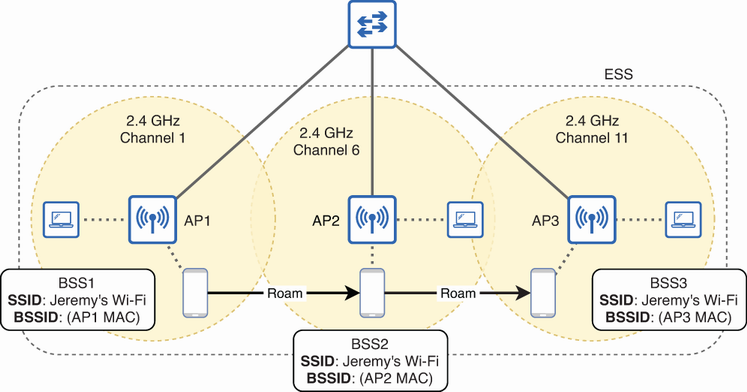
Shows an ESS in which multiple BSSs use one SSID, retain unique BSSIDs, and support seamless client roaming. section 18.3.3
