liveBook · Manning

Extended service set

As explained in Acing the CCNA Exam: Volume 2 Advanced Networking and Security

An extended service set is a wireless LAN formed by multiple basic service sets connected through a distribution system and presenting a common SSID.

An extended service set (ESS) expands wireless coverage beyond one access point by linking multiple basic service sets through a distribution system. Each BSS has a unique BSSID, while all share one SSID, making the ESS appear as a single wireless network. section 18.3.3

An ESS provides these operational characteristics:

  • Clients can move between AP coverage areas without manually reconnecting; this handoff between BSSs is called roaming. section 18.3.3
  • Each BSS normally uses a different non-overlapping channel, such as the 1–6–11 pattern, to reduce interference. section 18.3.3
  • Overlapping neighboring cells by roughly 10–15 percent, with some recommendations reaching 20 percent, supports seamless roaming. section 18.3.3

Enterprise office coverage

An office with three APs can form one ESS named “Jeremy’s Wi-Fi.” Each AP provides a BSS with its own BSSID and channel, while a client moves between them as signal strength changes. section 18.3.3

Figure 18.17 An ESS consisting of three BSSs. Each BSS shares the same SSID, but has a unique BSSID. A client can roam seamlessly between BSSs.
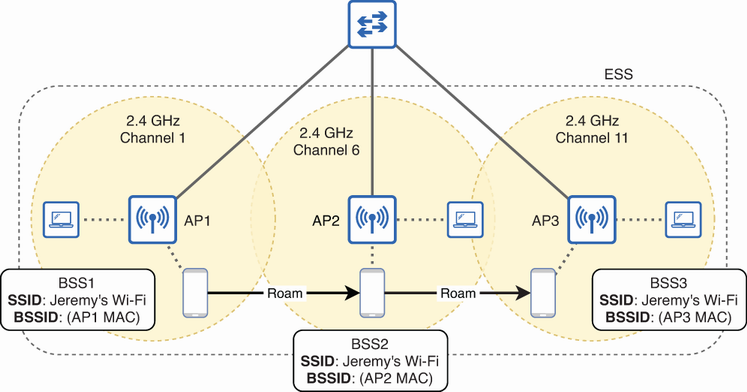
Use the topology figure to compare the shared SSID, unique BSSIDs, and roaming path across three BSSs. section 18.3.3

How Acing the CCNA Exam: Volume 2 Advanced Networking and Security covers it

How deep it goes
Explains ESS structure, SSID and BSSID identity, channel planning, roaming, and cell overlap without configuration procedures.
Examples
Uses an office ESS with three BSSs, shared SSID, unique BSSIDs, non-overlapping channels, and roaming clients.
What it assumes
Assumes basic electromagnetic waves, RF bands, 802.11 standards, wireless LANs, and basic service sets.
What you can do after
Evaluate how multiple access points provide continuous wireless coverage and identify the SSID, BSSID, channel, and roaming roles.
How it connects
Connects basic service sets, access points, distribution systems, SSIDs, BSSIDs, wireless LANs, channels, and roaming.

Related concepts

This explainer was generated by Manning's knowledge graph from the text of Acing the CCNA Exam: Volume 2 Advanced Networking and Security. The section links point to the parts of the book it draws on.