A distribution system (DS) interconnects basic service sets (BSSs), allowing wireless clients to reach hosts outside their own BSS. In an extended service set (ESS), the DS links multiple access points so one WLAN can provide wider coverage and roaming. section 18.3.2 section 18.3.3
Key operational points:
- Carries traffic between BSSs and the rest of the network, rather than allowing clients in separate BSSs to communicate directly. section 18.3.2
- Supports an ESS in which each BSS has a unique BSSID, while the BSSs share one SSID for a single user-visible WLAN. section 18.3.3
- Uses WLC distribution system ports as physical network connections; those ports can form a LAG for bandwidth and redundancy. section 21.2.1
Enterprise WLAN
Three BSSs can connect through a DS to form an ESS. A client sees one SSID and can roam between APs as signal strength changes, while the DS connects the WLAN to the wider network. section 18.3.3 section 18.3.2
Figure 18.16 The DS connects each BSS to the rest of the network, enabling wireless clients to communicate with hosts outside of their BSSs.
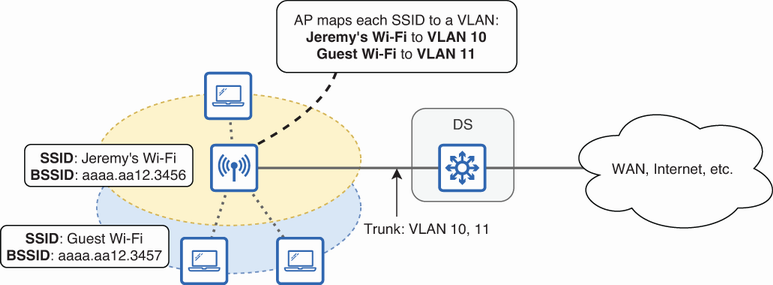
Visualizes how the DS connects each BSS to the rest of the network and enables communication beyond individual BSS boundaries. section 18.3.2
