A mesh basic service set (MBSS) connects multiple access points wirelessly, allowing them to relay traffic between wireless clients and the distribution system (DS) where cabling each access point is impractical or costly. section 18.3 section 18.3.4
An MBSS uses two access-point roles and can divide client service from mesh relay work:
- A root access point (RAP) connects to the DS. section 18.3.4
- A mesh access point (MAP) lacks a DS connection and relays traffic wirelessly through the mesh. section 18.3.4
- A two-radio AP should dedicate one radio to its client BSS and another, on a different channel, to mesh relaying. section 18.3.4
- A single-radio AP can participate, but its radio must perform both roles, greatly reducing performance. section 18.3.4
Cabling-constrained coverage
Place a RAP where the DS is available and use MAPs to extend wireless coverage into areas where Ethernet cabling to every AP would be impractical or too costly. section 18.3.4
Figure 18.18 An MBSS is a mesh of wireless connections between two types of APs, RAPs and MAPs, that allows them to relay data to and from wireless clients.
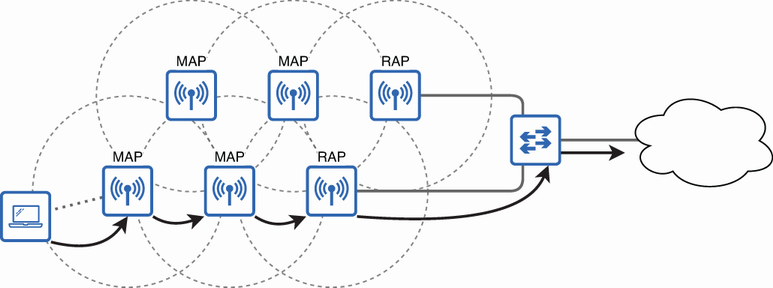
Shows the wireless mesh connections between RAPs and MAPs as they relay data to and from wireless clients. section 18.3.4
