liveBook · Manning

CSMA/CA

As explained in Acing the CCNA Exam: Volume 2 Advanced Networking and Security

CSMA/CA is a wireless media-access method in which devices sense a shared channel and defer transmission to reduce the likelihood of collisions.

CSMA/CA coordinates wireless devices competing for airtime on a shared, half-duplex medium. Devices sense the channel before transmitting, reducing—but not eliminating—the chance of collisions. section 18.1.1 section 18.5

A simplified CSMA/CA exchange proceeds as follows:

  • Prepare a frame and listen to determine whether the channel is free. section 18.1.1
  • Wait briefly for a random period when the channel is busy, then check again. section 18.1.1
  • Transmit only after sensing a free channel. section 18.1.1
  • Retransmit if simultaneous transmissions still produce a collision and an incoherent signal. section 18.1.1

Two wireless devices contend for airtime

Two devices prepare frames while sharing the same channel. Each listens first; a device that finds the channel busy waits randomly, while a device that finds it free transmits. If both transmit simultaneously, their frames can collide and require retransmission. section 18.1.1

Figure 18.3 The CSMA/CA process. To avoid collisions, a device will listen to ensure the channel is free before transmitting a frame.
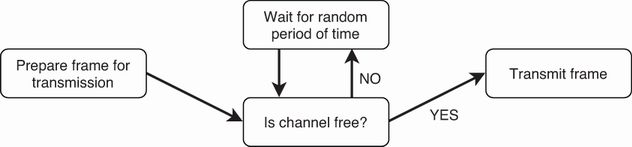
Follow the process diagram to visualize channel sensing before frame transmission. section 18.1.1

How Acing the CCNA Exam: Volume 2 Advanced Networking and Security covers it

How deep it goes
Defines sensing, random deferral, transmission, and retransmission but stops short of detailed timing mechanics.
Examples
Uses frame transmission, busy-channel deferral, simultaneous transmission, collision, and retransmission as concrete examples.
What it assumes
Assumes awareness of wireless devices and frames while establishing shared-medium contention and half-duplex behavior.
What you can do after
Evaluate/understand how wireless devices share airtime and why sensing cannot guarantee collision-free transmission.
How it connects
Connects wireless LANs, half-duplex operation, collisions, CSMA/CD, and interference.

Related concepts

This explainer was generated by Manning's knowledge graph from the text of Acing the CCNA Exam: Volume 2 Advanced Networking and Security. The section links point to the parts of the book it draws on.