A basis vector is one of the reference vectors used to build other vectors through addition and scalar multiplication. In two dimensions, i = (1, 0) and j = (0, 1) form the standard orthonormal basis, so a = (0.5, 1.5) can be written as 0.5i + 1.5j. The coefficients are the vector's coordinates in that basis. section 2.1.2
Keep these practical distinctions in view:
- Tuple notation and a weighted sum of basis vectors describe the same vector in the standard basis: (2, 3, 4) = 2i + 3j + 4k. section 9.1
- The standard basis is orthonormal because its vectors are perpendicular and have length 1; other bases may be nonorthogonal or non-normalized. section 2.1.2
- Changing the basis changes the reference directions and the coefficients used to represent a vector, while keeping the vector operations available. section 2.1.2
Representing a 3D vector in SymPy
SymPy models vectors as weighted sums of basis vectors in a coordinate system. After creating N with CoordSys3D('N'), write the vector (0, -1, 2) as 2*N.k - N.j. This representation also supports operations such as dot products. section 9.2.2
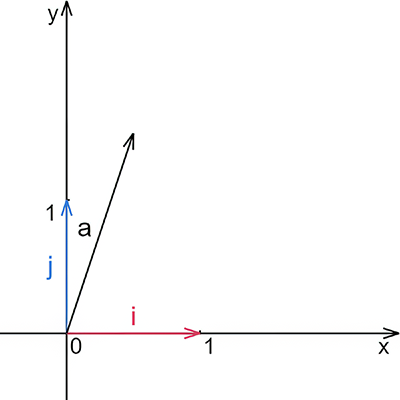
Visualizes a point vector as 0.5i + 1.5j in an orthonormal basis, connecting coefficients with geometric direction and length. section 2.1.2
