A Bayesian network is a probabilistic model that maps how events interact. Its directed acyclic graph uses nodes for variables and directed edges for conditional dependencies, helping track how evidence or changes in one variable affect others. section 3.5
Weather prediction
A weather network can connect a clouds node to a rain node. If cloudy conditions have a 40% likelihood, the model can assign a 30% chance of rain when it is cloudy and a 5% chance when it is not. section 3.5
Bayesian networks are useful when a project needs to:
- Represent probabilistic descriptions and calculate likelihoods across related scenarios. section 3.5
- Handle unlabeled data in unsupervised learning, including clustering tasks. section 3.8
Figure 3.5 An example of a Bayesian network
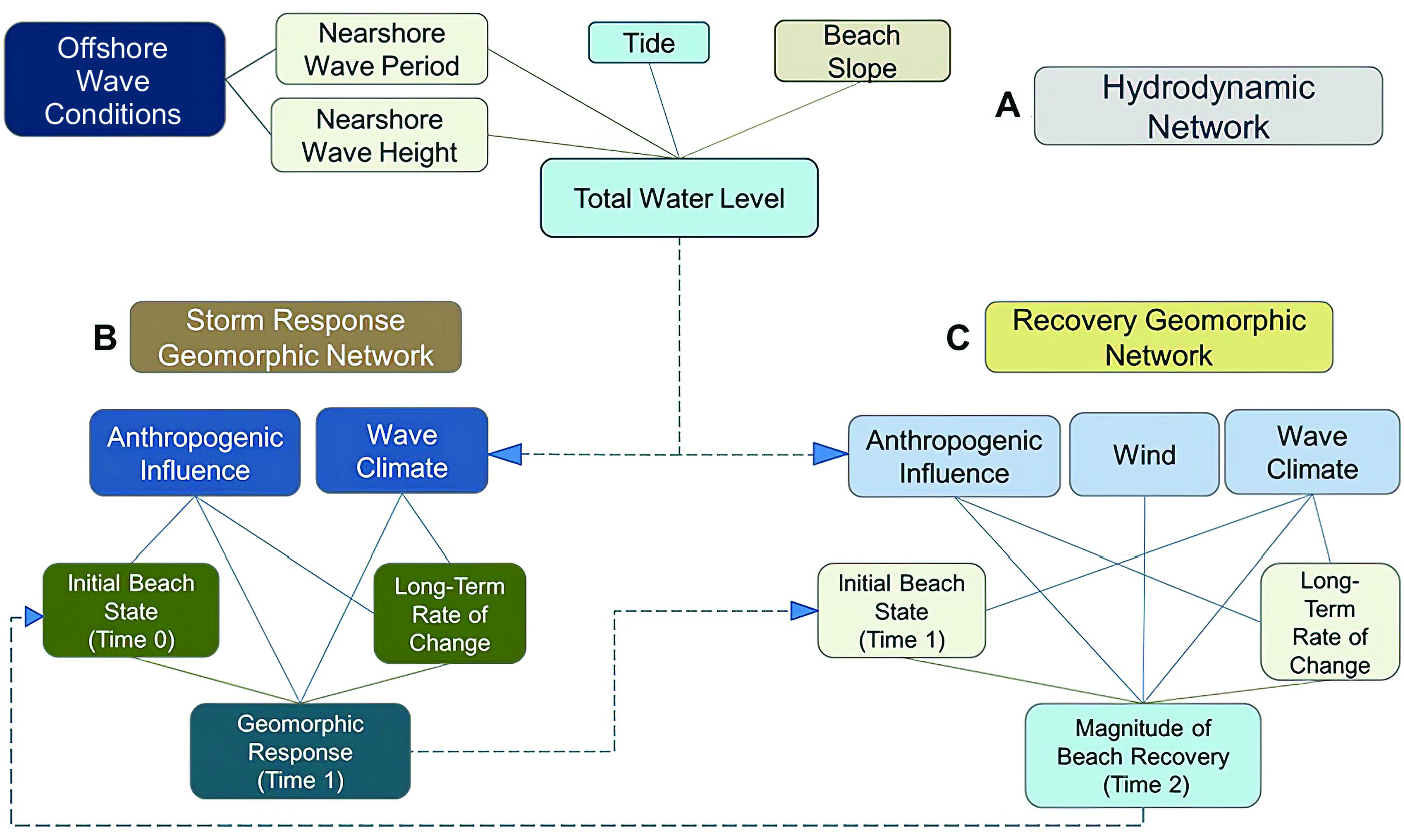
Use the network figure to see variables represented as nodes and dependencies represented as directed edges. section 3.5
